
‘My absolute superpower in work and life is …’

by Bernadette Motion
/1. ‘My absolute superpower in work and life is …’

I felt surprisingly down this week when I heard about Russell & Bromley going under. Not because I was worried about where to buy shoes – it was something personal.
You see, Russell & Bromley was never really a shop to me. It was a symbol. A quiet little signal that you'd arrived somewhere better, more polished, more grown-up. A bit like my husband's first Audi Quattro, years later. If you could afford to buy your shoes there, you were clearly doing something right.
Growing up in Liverpool, a trip to Chester or Southport felt like visiting another world. There were shops I didn't dare set foot in. Russell & Bromley practically glowed in my imagination. It sat alongside those Cinzano Bianco adverts – you know the ones – with glamorous women draped across yachts. Or that "Up, Up and Away" hot air balloon ad. A vision of adulthood that came with sunglasses, elegance and beautifully made things. I didn't really want the shoes. I wanted to become the woman who could walk in and buy them without a second thought.
My ambitions were all over the place back then. I wanted to go to university – the first in my family to do so – but I also fancied myself as either a bohemian or a jet-setter. I coveted the things that came with those identities: the corduroy lace-ups worn by "studenty" types, an Afghan coat straight out of Doctor Zhivago, or the kind of elegant shoes Russell & Bromley sold.
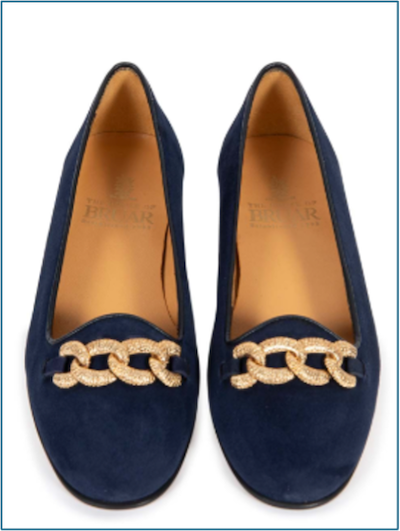
After working at the Beeb – brilliant travel, not-so-brilliant pay – I landed my first proper job in City PR. Think Fleet Street, the eighties, yuppies in shoulder pads. That's when I finally did it. I walked into Russell & Bromley and bought two pairs of suede pumps with a chunky gold chain across the front. One red. One black. I can picture them now. I'd made it.
Looking back, shoes mark out my life far more clearly than any CV ever could. Work shoes. Party shoes. The ones you stand in all day. The ones you kick off the moment you get home. When we had horses, there were wellies – endlessly practical, endlessly muddy. Then came a foot injury, and I've lived in trainers for the best part of twenty years since. Comfort won. Function beat fantasy.
“Somewhere along the way, the wanting faded.”
There's very little now that I actively covet. You might think that's because I'm lucky enough to afford most things I want. Or because I already have them. But honestly, it's because life has taught me that stuff only does so much. Aspiration doesn't disappear as you get older – it just changes shape.
It was never really about the shoes. It was about belonging. The idea that if you collected the right props, the confidence would follow. When you're young, those markers are visible – things you can see and touch. Later on, they're quieter, harder to spot. That's why the end of Russell & Bromley feels oddly personal. It's not nostalgia for the product. It's nostalgia for my younger self – the girl who believed that one day, if she worked hard enough, she'd walk into the right shop and everything would fall into place.
I've come to realise that money works the same way. Early on, some of us chase the symbols of success. Later, we come to value family, health, comfort, independence and peace of mind. Like shoes, our relationship with money evolves. And if you're lucky, you end up somewhere where what you have supports the life you actually want – rather than trying to define it.
/2. Regrets? I've had a few – even though I've worked in finance
Regrets? Hah! I've certainly made my share when it comes to money. Which might surprise people, given what I do for a living – financial PR, former City journalist.
People assume I'm good with money. It's a fair assumption. I've worked around finance for most of my adult life. I'm married to an ex-stockbroker. I talk the talk. I know the difference between investing and saving, between risk and reward, I can outline asset allocation, emerging markets and blue chips. I can even follow the plot of Industry.
Friends often come to me when they need help with anything financial – which, these days, increasingly means retirement income. Or the lack of it.
But knowing about money isn't the same as having made the right decisions with it. Proximity breeds familiarity, not immunity. If anything, it made it easier to believe I didn't need help – until I very obviously did.
On the surface, my relationship with money looks sensible enough. I've always worked. I've earned my own money. I've steered clear of debt. I've paid for my children, their education, their (often expensive, equine...) passions – and still bail them out occasionally, as parents do. I've been financially independent and proud of it. I've cut my cloth to fit my coat, lived within my means, and got on with things. But that's not the same as having planned properly.

Too often the ‘future me’ just didn’t have the planning it needed.
My biggest mistake, with hindsight, was not starting to save for the long term early enough. I saved, yes – but I saved to spend, not to build. When I did invest – and it was never huge sums – I was drawn to the exciting stuff: emerging markets, those dazzling "friends and family" opportunities. All marvellous until markets crashed or I needed the cash for something else.
I did all this without truly grasping the power of compounding – that so-called eighth wonder of the world. It wasn't a lack of intelligence. It was a lack of attention. Retirement felt abstract. My future self felt theoretical. The other mistake, closely related, was stopping my pension contributions far too early. Life got in the way, as it tends to. There were years when keeping everything afloat felt more urgent than feeding a pot I wouldn't touch for decades. At the time, it seemed practical. Necessary, even. Looking back, I can see how costly that decision was.
And my due diligence? If I'm honest, it was pretty casual.
I remember shouting upstairs to my husband, asking if we'd manage in later life on his pension. He said, "Probably."
That was good enough for me. I was juggling work, family, health, the endless logistics of daily life. I didn't feel negligent. I felt busy.
Then there's the small matter of actually asking for money. I hate it. I can negotiate for other people without batting an eyelid – it's part of my job – but speaking up for myself has always been harder. Going freelance exposed that weakness. Before, someone else had always handled my fees.
None of this makes me unusual. In fact, it makes me utterly typical of women my age. We were encouraged to work but not always taught to plan. We were capable but stretched thin. We held everything together, often without stopping to ask whether the structure underneath actually made sense.
What finally shifted things wasn't some dramatic crisis. It was a quiet, nagging anxiety. The constant checking of my ragbag of pension pots. The endless mental arithmetic. I wanted someone else to take it off my hands. I wanted reassurance more than control.
Here’s the part that took me longest to understand.
My absolute superpower in work and life is an instinctive ability to jump from A to Z without trudging through every intermediate step.
I have little interest in process. I loathe admin and don’t want to look under the bonnet. I just want to turn the key and have the car go. This has served me brilliantly in some areas. And with people, I’m endlessly curious about their inner lives, motivations, and emotions. Systems, less so. Money, unfortunately, is a system.
As life has become fuller and noisier, my tolerance for holding financial complexity in my head has dropped. Not because I can’t understand it, but because I don’t want to carry it – I want to outsource it to others who are better resourced and experienced, who can be the sanity check, and who can take all the underlying decision making out of my head.
Outsourcing my financial planning wasn't an admission of failure. It was a relief. It was accepting that I didn't need to be across every detail to be competent. That asking for help wasn't proof I'd got it wrong – it was a way of getting it right from here.
I've made mistakes. I've had regrets. Thankfully, most of them were fixable. But the biggest lesson I've learned is this: thinking you understand money doesn't mean you don't need advice. Often, it's exactly why you should get some. Warren Buffett didn’t work on his own.
About the author
Bernadette Motion is not technically employed by Chancery Lane but has been an integral part of our team for donkey's years. Her background is in financial journalism - from the Beeb to nationals and mags. She now specialises in financial PR – though like the ‘two Claires’ she might say her biggest job is being a mum. She was fondly known as the Bridget Jones of Fleet St and PR in her youth, and knows about every journo out there, making sure they know about Chancery Lane.