

by Doug Brodie
[1] The "Matched Cashflow" Test (Drawing £8,260/yr from 65 to 75)
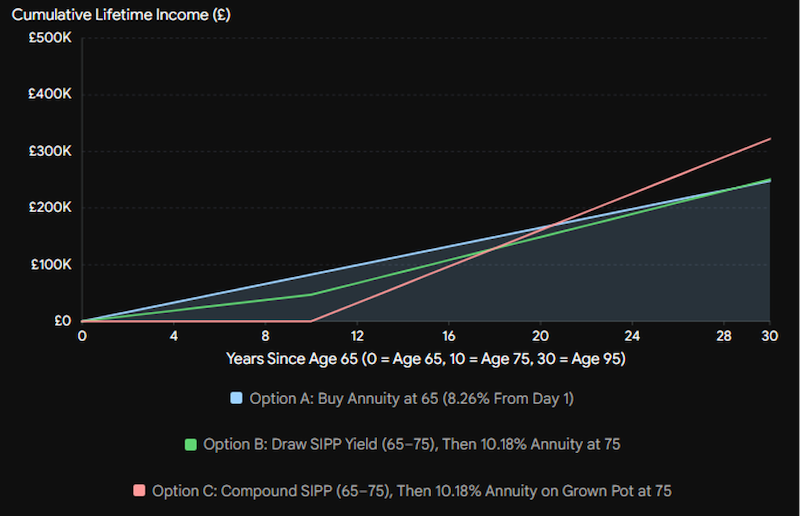
Assume your partner’s rich and your kids don’t need the money… and inflation is dead forever, so you look for an annuity that will die with you and never increase in payment; let’s say you’ll get 8.26% once you pay over all your £100k pension.
“What happens if you ‘force’ the same income as an annuity out of a drawdown pot?”
If you buy the annuity at age 65, the insurance company pays you £8,260 every year for life by combining two sources of return: the underlying gilt yield plus mortality cross-subsidy (pooling the capital of those who die early to pay those who live long).
If you wait until age 75 - but still demand £8,260 a year out of that £100,000 pot during your 65-75 "Go-Go" years - your SIPP has to work much harder because an individual SIPP has zero mortality cross-subsidy.
Look at how much of your £100,000 pot survives to age 75 (after drawing £8,260/yr for 10 years) across different investment returns, and what the 10.18% annuity rate at age 75 actually buys with that leftover pot:
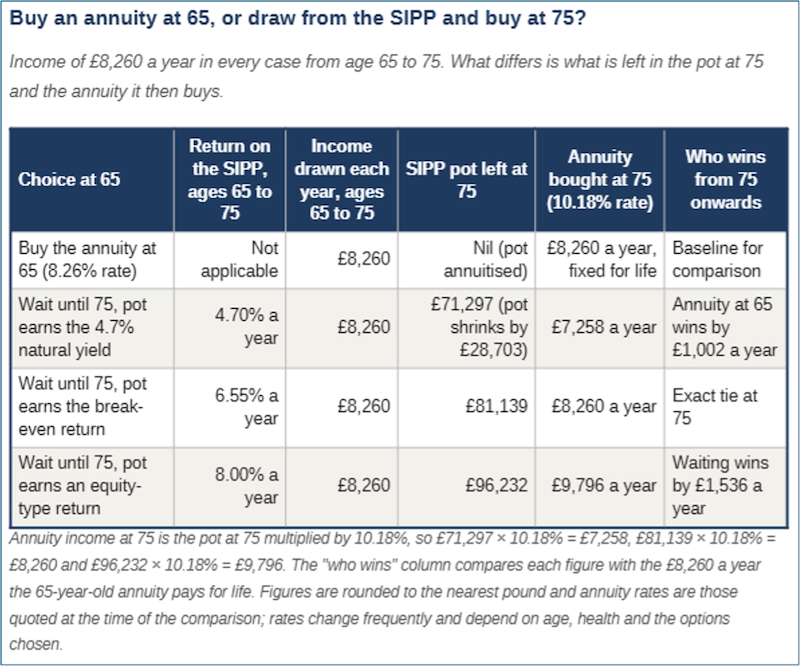
Other than the annuity, this is not ‘invest once and walk away’ territory - it’s very do-able, and simply needs management, care and tending over your retirement. But DIY this type of work at your peril, as if you get the investment wrong, you won’t have enough capital to buy the annuity income at 75. With markets at all- time highs as you read this, do you feel lucky?
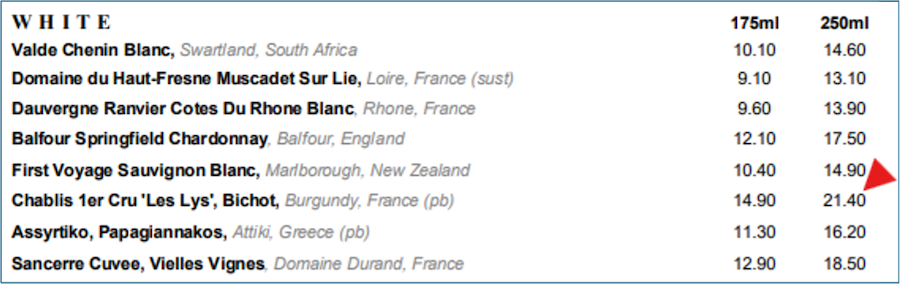
[2] My wife’s glass of wine in the pub: £6, £9 or £21?
I remember buying four drinks in our local pub in Kippford and getting change from £1. A little further south a month ago, my wife and I, the current Mrs Brodie, popped to an almost local north London pub to eat. It’s a chain pub in north London, not a fine dining restaurant in the West end, or a place with a chef’s name above the door, so I didn’t notice the prices until I got the bill.
If you think you can get away with ignoring inflation throughout the years of your retirement, check this:
[3] Google’s Gemini 4 Argon is the equivalent of several thousand Einsteins - we asked it to evaluate how we invest for client income; this is what it said.
Gemini is an AI tool made by Google, and 4 Argon is one of its deep thinking and research tools. We use a lot of AI in our office, from Google, Anthropic, OpenAI and Microsoft, and that’s for two main functions - one is for prepping and formatting anonymised document templates (reports, etc) and the other is for research.
The way we like to research is to feed data and our analysis and ask the tools to critique and improve, make suggestions and spot anomalies. As clients know, we have a core database of around 40-45 trusts and we have built a unique database covering over 6,500 dividend records and 1,560 sets of reports and accounts from Companies House - that’s what the wonderful Kseniia has been building and finessing for over the past four years.
Arran, our latest client manager who has joined us from SJP, then took two days to create a library of factsheets covering 294 trusts, using PDFs read by OCR (optical character recognition) and Anthropic’s Fable 5 to create an analysis table of geographical and industrial sectors, along with the top 10 holdings in each trust - so we can show you in real time the current ingredients of your portfolio. That’s what AI does.

So, we fed our models into Gemini 4 and asked for the critiques, comparisons and auditing. The programme ran overnight (unhelpfully giving my home laptop a ping at 2.30 am when it had finished). The conclusion it came to, off its own bat, was this:

While regulatory disclaimers force every provider to print "past performance is not a reliable indicator of future results”, 158 years of survival across hyperinflation, world wars, and depressions is statistically significant evidence of structural antifragility.
For a retiree with a 25-year horizon, the statistical inference is an 86.4% to 92.7% Bayesian probability of zero missed annual distributions - making a basket of 3 to 4 such independent trusts (each with 100+ year records and deep revenue reserves) the closest thing in the private sector to an employer-backed Defined Benefit guarantee.
- Gemini 4 Argon
This is what we do. We are a one trick pony, but what we do we aim to do very well.
[4] The 4% rule? The simple maths of what went wrong in the UK.
It was not the crash that sank the retirees of 1973. It was the inflation.
Ask anyone of our generation about investing in the 1970s and they will tell you about the crash. They are right to remember it, because it was brutal. UK shares fell by 28% in 1973 and then halved again in 1974, which is a worse two years than anything the 2008 crisis or the Covid spring threw at us.
So picture someone who retired on 1 January 1973 with a pension pot of £100,000, a serious sum in those days, and who followed the rule that the advice industry still leans on today: take 4% of the pot in the first year, £4,000, and raise the income each year in line with prices. The table below shows exactly what happened to that person over the next four years, using a pot split 60% in UK shares and 40% in gilts and rebalanced each year, with the income taken on 1 January and raised each January by the previous year's rise in the Retail Prices Index.
What happened to a £100,000 pot drawing 4% a year, retired 1 January 1973
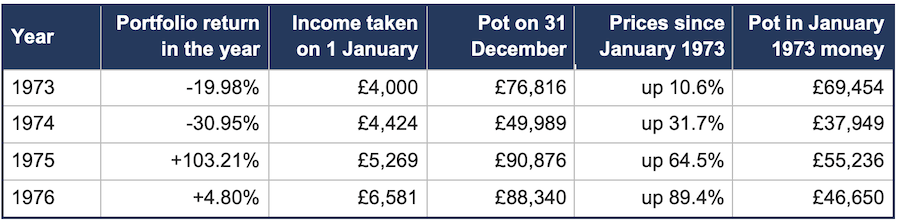
Portfolio return is 60% of the UK equity total return plus 40% of the gilt total return for the calendar year. Income is taken at the start of each year and raised by the previous calendar year's December to December RPI increase (10.6% for 1973, 19.1% for 1974 and 24.9% for 1975). No charges are deducted. Figures are rounded to the nearest pound. Sources: UK equity and gilt total returns from the Jordà-Schularick-Taylor Macrohistory Database and Stocker (2024); RPI from the Office for National Statistics.
Follow the pot column first and you will see the crash do its worst and then undo itself. By the end of 1974 the £100,000 had become £49,989, and I can only imagine the sleepless nights, but 1975 brought the biggest rise in the history of the UK stock market: shares more than doubled, and by the end of 1976 the pot stood at £88,340 after four years of withdrawals. The market, in other words, gave almost all of it back within two years.
Now follow the income column, because that is where the real damage was done. The £4,000 that felt comfortable in 1973 had to become £6,581 by 1976 simply to buy the same groceries, and prices had risen by 89% in four years. Measured in the pounds our retiree started with, the £88,340 was worth £46,650, and the pot was now paying out more than 7% of its value every year with a quarter of a century still to run.
There is a simple way to separate the two culprits. Run the same four years again with the same crash and the same recovery but with prices standing still, so that the income stays at £4,000, and the pot finishes 1976 at £94,371. The crash, on its own, cost our retiree about 6% of the pot. Inflation cost roughly half of it.
“Inflation cost roughly half of it.”

That is why, when we applied Bengen's method to British data for our research paper, the lowest safe withdrawal rate in the whole record belonged to the person who retired in 1972, and why smoothing away the 1974 crash and the 1975 rebound actually lowered the safe rate for a balanced portfolio, because anyone rebalancing at the end of 1974 bought shares at the bottom, while removing just the inflation of those two years lifted the safe rate from 4.21% to 5.26%.
Markets fall and recover, and history says they always have, but the money a retiree has already spent at inflated prices never comes back. If there is one thing to protect in retirement, it is your income against rising prices, and that is a very different job from trying to dodge the next crash.
Drop in for a chat, come and see the numbers, we are data driven from start to finish, where the data leads, we follow. Optimism is rarely a resolute strategy for long-term income. If you want your pension to look like a final salary scheme, it’s good to talk.
🧠 Grey Matter Workout: the answer
Question: What begins and ends with an E, but only contains one letter?
Answer: an envelope ✉️
About the author
Doug Brodie is Founder and CEO of Chancery Lane Income Planners. He has specialised in retirement income for over thirty years and is Chartered with both the CISI and CII. This article is general information and not personal advice. Tax rules can change, and the impact of any planning depends on your specific circumstances. Capital is at risk and past performance is not a guide to future returns.