
Welcome to the Hotel California

by Doug Brodie
/1. Pension Basics - what your pension actually is
Most people who have had a pension for forty years have never been told, plainly, what one is. So, briefly, and without the brochure language.
A pension is an income paid to you when you have retired or have passed retirement age. A final salary pension, your state pension, they are both precisely that. A money purchase pension pot is not a pension; it is a pension savings account which is to be used to provide you with a pension.
A pension pot is not a thing. It is a tax wrapper sitting around a pile of investments. The wrapper does three useful things:
Going in: the government tops up your contributions through tax relief. A basic-rate taxpayer’s £80 becomes £100 in the pension; a higher-rate taxpayer’s £60 effectively becomes £100. Tax relief is, mechanically, the most generous gift the State has ever made to ordinary savers, and it is why pensions are worth having in the first place.
Inside: the investments grow free of capital gains tax and free of income tax on dividends. Compounded over thirty or forty years, the difference versus a taxable account is the difference between a comfortable retirement and a stressful one.
Coming out: you can normally take 25% as a tax-free lump sum (formally the Pension Commencement Lump Sum, capped for most people at £268,275). The remainder is taxable as income at your marginal rate when you draw it.
There are two species of pension.
Defined Benefit (DB) - the old-fashioned final-salary kind - pays a guaranteed income for life, typically based on salary and service. Most baby boomers in the private sector saw these closed to new entrants between roughly 1985 and 2010.
Defined Contribution (DC) - what most of us have now - is a pot of money in your own name; you decide how to invest it and how to draw it. It is the same as a personal pension or a SIPP. It is also known as a money purchase pension.
SIPP: Self Invested Personal Pension. It’s a personal pension just like any other, however this type is where you are in charge of the investments, as opposed to a pension company’s personal pension where they have already decided on what investment funds you can use. Just because it says ‘self-invested’ doesn’t mean you have to do the investments: you can if you want, but most people choose to appoint professional managers to do this for them.
The State Pension is in a different animal entirely: it is a benefit paid by the government, not a personal asset, and it dies with you. It is now £12,548 per person, or £25,096 for two people with full entitlement. Currently guaranteed to increase by a minimum 2.5% per year via the triple lock. This year, it rose by 4.8%, keeping up with inflation.
When you retire from work, your DC pension gives you four broad options:
Take it all as cash - rarely sensible, because three-quarters of it would all be taxable then and there, at your highest rate
Buy an annuity - last week’s article covered the rates, which are currently the most attractive in over a decade
Keep it invested and draw an income from it - known as drawdown, and the route most retirees now use
Some combination of the above
Most retirements, then, end up using drawdown - and drawdown is precisely where the new IHT rule lands hardest. Read on.
/2. Hotel California: what’s changing on 6 April 2027
On a dark desert highway
Cool wind in my hair
Warm smell of colitas
Rising up through the air
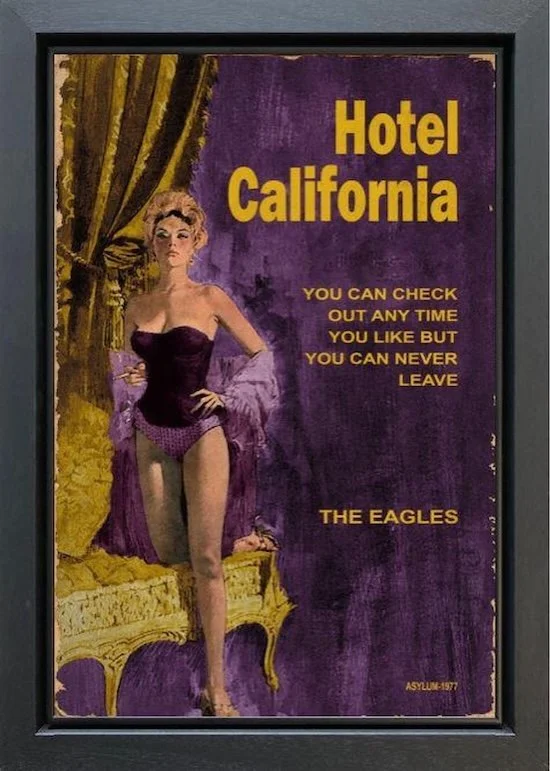
The line in the song that sticks is about checking out but not being able to leave; it’s about addiction, both to substances and also to hedonism, taking into account the Los Angeles of the mid 70s. It is also about getting addicted to money and not being able to walk away from it – think of retiring from a fat wage and not being able to leave the high-cost lifestyle. We see that in people; it’s a real thing.
In her first Budget on 30 October 2024, Chancellor Rachel Reeves announced that, from 6 April 2027, most unused pension funds and pension death benefits will be brought inside the IHT estate. The technical consultation closed in January 2025; the Government’s response was published in July 2025; the Finance Bill 2025-26 contains the legislation; and the November 2025 Budget added some helpful administrative tweaks but did not change the direction of travel.
The change is happening. Plan accordingly.
In plain English: when you die on or after 6 April 2027, whatever is left in your pension pot will be added to the value of your other assets - house, investments, cash, the lot - and the whole thing will be tested against the IHT thresholds.
The thresholds, as a reminder:
£325,000 - the standard nil-rate band, frozen since April 2009
£175,000 - the residence nil-rate band, available where the home passes to direct descendants
A married couple or civil partners can pass unused thresholds between them: a survivor’s estate can therefore have up to £1,000,000 sheltered from IHT
These thresholds are now frozen until April 2031 (extended in the November 2025 Budget)
Above the thresholds, IHT is charged at 40%
The residence nil-rate band tapers away on estates above £2 million, at the rate of £1 lost for every £2 over
Three details that tend to get missed in the headlines:
The spousal exemption is preserved. Whatever passes from you to your husband, wife or civil partner remains free of IHT, pension included. The bill is deferred, not eliminated - it lands when the second spouse dies.
Death-in-service benefits are excluded. If you are still working when you die and your employer’s scheme pays a lump sum, that remains outside the IHT estate.
The combined effect with income tax can be brutal. If you die after your 75th birthday, anything your beneficiaries draw from the inherited pension is also taxable as income at their marginal rate. The Government’s own consultation response acknowledged that effective tax rates on pension legacies could approach two-thirds in some cases.
Death in service benefits payable from both discretionary and non-discretionary registered pension schemes will be excluded from Inheritance Tax. The existing Inheritance Tax principles providing exemption for death benefits passing to a surviving spouse or civil partner, and registered charities will be maintained.
- HMRC
If you find yourself unable to sleep, or if government legislation is your thing, the current Finance Act 2026 writing on avoidance of double taxation on an inherited pension is here:
Government estimates are sobering but not apocalyptic. Of around 213,000 estates a year holding inheritable pension wealth, the Treasury expects roughly 10,500 to become newly liable for IHT and a further 38,500 to pay more than they otherwise would have. The average extra bill is forecast at around £34,000 per affected estate, but, as ever, averages hide the real story. Many of our clients will see far higher numbers - which is the point of the next section.
/3. £280,000: a worked example, in pounds and pence
Numbers cut through theory. Meet Emily.
Emily is 73, widowed since her early sixties, lives in a sensible Surrey semi, and has two grown-up children. Like many of you, she did the right things: paid into a pension throughout her working life, lived prudently, and never quite got round to blowing the pension because the State Pension and her late husband’s small DB scheme cover the bills nicely. Her wealth on the day of her death looks like this:
|
Asset |
Value |
|
Home (going to her two children) |
£500,000 |
|
ISAs |
£100,000 |
|
Cash savings |
£200,000 |
|
DC pension (untouched) |
£700,000 |
|
Total wealth |
£1,500,000 |
Emily’s late husband used his nil-rate band when he died (his estate didn’t all pass spouse-to-spouse), so Emily has only her own allowances available:
£325,000 nil-rate band
£175,000 residence nil-rate band (her home is passing to direct descendants)
£500,000 total sheltered from IHT
BEFORE If Emily dies before 6 April 2027:
IHT-able estate (excludes pension): £500,000 + £100,000 + £200,000 = £800,000
Less allowances: £800,000 − £500,000 = £300,000 taxable
IHT at 40% = £120,000
The £700,000 pension passes to her children outside IHT, taxable on them as income at their marginal rate as they draw it down
AFTER If Emily dies on or after 6 April 2027:
IHT-able estate (now includes pension): £800,000 + £700,000 = £1,500,000
Less allowances: £1,500,000 − £500,000 = £1,000,000 taxable
IHT at 40% = £400,000
The pension still passes to her children, but with the IHT now stripped from it before they receive it
The arithmetic of the change: £400,000 − £120,000 = £280,000 of additional Inheritance Tax, almost entirely attributable to bringing the pension inside the estate.
That £280,000 is, almost exactly, 40% of Emily’s pension pot. Which, of course, it should be - that is what the rule says.
There is one further wrinkle the headlines often miss. Because Emily died after her 75th birthday, anything her children subsequently draw from the inherited pension is also taxable on them as income at their marginal rate. If both children are higher-rate taxpayers, they will pay another roughly 40% of the post-IHT residue as they draw it down. The combined effective tax rate on Emily’s pension legacy can quietly approach two-thirds.
Read that figure twice. Then make a cup of tea and re-read it. Then book the appointment we mention at the bottom of this article – we don’t do schemes and wheezes, but it’s good to talk.
/4. Four conversations to have - now, not in 2027
Here is the empathy bit, because the maths above is cold and the human consequences are not.
Most clients I meet have spent the last decade hearing “don’t touch the pension, it’s outside IHT”. That advice was correct. It is now around eleven months from being the wrong advice. The order in which you spend your wealth - the very plumbing of your retirement income plan - needs to be reconsidered before April 2027, not after.
There are four conversations worth having between now and then.
1. With your spouse: who dies first, and what happens then?
The spousal exemption survives. Whatever passes between husband and wife or civil partners remains IHT-free. But the bill comes due on the second death - and the second death is, in our experience, the harder one to plan for, because it tends to involve a surviving spouse handling paperwork they didn’t set up or may not fully understand. Whose pension is bigger? Whose is in drawdown? Whose nomination form still names a sister-in-law from 1992?
2. With your children: tell them the order is changing.
Many of our clients’ adult children are quietly planning their own lives on the assumption of an inheritance that includes the pension intact. After April 2027, it may be 40% lighter on arrival, and after the income tax on drawdown, more like 60% lighter. They are entitled to know. We have seen too many families discover this together in the executor’s office - at, frankly, the worst possible moment.
3. With your adviser: should the spending order reverse?
The conventional wisdom - spend ISAs first, taxable accounts second, pension last - was built on a world where pensions sat outside IHT. From April 2027, that ordering may actively destroy family wealth. For some of our clients, drawing the pension first and preserving the ISA wrapper for the legacy is now the better answer. For others, increased lifetime gifting from the pension (using the seven-year rule, or the regular gifts out of surplus income exemption, both of which are very much still on the books) is part of the solution. There is no single right answer, but there is definitely a wrong one - which is doing nothing.
4. With yourself: am I prepared to spend the money?
This is the quiet conversation, and the most important. Many clients in their late sixties and seventies have, in effect, stopped spending. The holiday curtailed, the new car deferred, the kitchen extension parked, the garden left to the brambles. Saving in retirement is a strange habit - and one that the new IHT rule punishes severely. If your pension is destined for a 60% combined tax charge on the way to your children, the rational response is, frankly, to enjoy more of it yourself while you can. Spending in retirement is not a moral failing. It is, in many cases, the most tax-efficient thing you can do.
We talk about all four of these in our initial discussions. (It’s not all about the Eagles). None of it is comfortable. All of it is necessary.
So - checking out, are we?
The Eagles closed Hotel California with that famous line about leaving and not leaving. HMRC has, in effect, set the song to a new arrangement. Your pension can check out - but from 6 April 2027, a substantial slice of it is staying behind, with HMRC’s compliments.
The good news is that this is all eminently plannable. The rules are almost settled. The thresholds are known. The arithmetic is ours to do. Eleven months is more than enough time to put a sensible structure in place - provided the conversation starts now and not next April.
If any of this has made you put down the toast, that is precisely the feeling that should prompt a phone call. Not because we will panic you into anything - we don’t do that - but because the cost of an hour of our time is zero, and the cost of leaving this until your children are sitting in a solicitor’s office can be measured in six figures.
Book a call, meeting, Zoom/Teams chat
020 7390 0670
Two hours, both spouses, no jargon, no pitch. We bring the coffee. You bring the questions, the pension statements, and - if you can find them - the nomination forms.
About the author
Doug Brodie is Founder and CEO of Chancery Lane Income Planners. He has specialised in retirement income for over thirty years and is Chartered with both the CISI and CII. This article is general information and not personal advice. Tax rules can change, and the impact of any planning depends on your specific circumstances. Capital is at risk and past performance is not a guide to future returns.