
A gilt ladder and the annuity nobody wants to buy

by Doug Brodie
[1] A gilt ladder today for £500,000
Suppose you have £500,000 of pension money and you want to know, to the pound, what it will pay you and on which day. Not a projection. Not a range with a footnote. A date and a number.
That is what a gilt ladder does. You buy five UK government bonds, one maturing in each of the next five years. Each hands back a known sum on a known date. The price moves around in the meantime, and provided you hold to maturity, that movement is irrelevant to you.
Here is a real one, priced on 15 September 2026, with £100,000 of consideration in each rung.
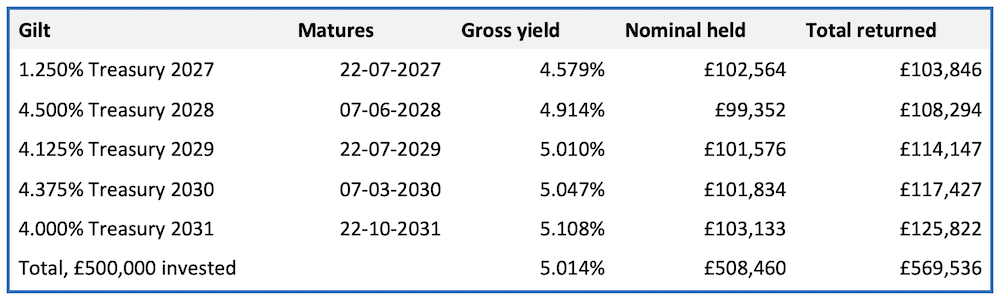
Prices and yields as at 15 September 2026, giltsyield.com, for settlement the following day.
Working: £61,076 of coupon interest plus £508,460 of capital returned equals £569,536, a surplus of £69,536 on the £500,000 that left your account. The blended gross redemption yield across the whole book is 5.014% a year.
The part most articles leave out
Now suppose you spend none of it, and reinvest each maturity through to a single date, 31 January 2032. Set that against the laziest alternative available: buying one gilt today, the 1.000% Treasury Gilt 2032, and leaving it alone.
The ladder finishes at £654,221. The single gilt finishes at £654,441. A difference of £220 on half a million pounds over five and a half years.
That is not a rounding error. It is the whole point. A rising yield curve is the market telling you, in advance, that it expects rates to be higher later on. The rise the ladder is built to capture is already in today’s prices. When your first rung matures in July 2027, the market implies you will reinvest for four and a half years at about 5.21%, against 5.05% for that same term today.
So, the ladder wins only if rates rise by more than the market already expects. Every extra 0.50% adds roughly £7,955. If yields simply stay where they are, the ladder finishes £4,288 behind. Choose a ladder for the certainty and timing of its cashflows, and for the option value of having money to reinvest. Do not choose it because somebody has told you rates are going up.
What if you intend to spend the lot?
This is the question we are actually asked most often. Gilts only, £500,000, a level income each year, the capital deliberately running to nil at the end.
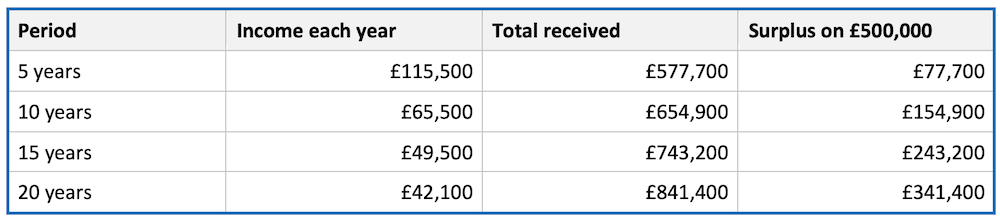
Gross, and this is pension money, so there is no tax to consider at any point.
Working the maths - for the twenty-year column: each year’s payment is discounted at the gilt yield for that year, running from 4.64% in year one to 5.97% in year twenty. Those twenty factors add to 11.8847. £500,000 divided by 11.8847 gives £42,071 a year, which returns £841,419 in total.
It’s important to look at what that last line is saying. Twenty years of £42,071 from £500,000 of capital. The extra £341,419 is simply what the government pays you for waiting.
Two honest caveats. These are gross figures, before charges, and on a low return asset, those take a larger share than they would elsewhere. A conventional gilt pays a fixed number of pounds, so it offers no protection against inflation. Twenty years of 3% inflation would leave that final £42,071 worth about £23,300 in today’s money. Index-linked gilts are the direct answer, and a different conversation.
[2] The annuity nobody wants to buy
There is a product almost nobody researches in advance and a great many families end up needing in a hurry. It is called an immediate needs annuity, sometimes an immediate care plan. You hand an insurer a lump sum and it pays a guaranteed income, for the rest of that person’s life, towards the cost of their care.
It is usually bought at the worst possible moment, by a son or daughter, within weeks of a parent moving into a home. Which is why it is worth understanding now, while nobody is upset.
Where it is needed
The problem it solves is not the cost of care. It is the open end.
A care home place is a known number. What nobody can tell you is how many years it runs for. Two years is affordable for most estates. Eleven is not. A family self-funding from capital is carrying an uncovered bet on how long somebody lives, usually placed by the person least able to think clearly about it.
An immediate needs annuity closes that end. Whatever the fees, for however long, they are met.
So, it earns its place where there is real capital, where care is needed now, and where the family would be genuinely exposed if the person lived a long time. It is not the answer for someone with modest savings, where local authority support is the route, and it is not something to buy at 68 in case. Nor is it a substitute for checking NHS Continuing Healthcare eligibility first.
Two things to understand before committing
It is paid to the care provider, not to the person. This is not administrative tidiness, it is a condition of the tax treatment. HMRC’s Insurance Policyholder Taxation Manual is clear that the income is free of income tax only if it goes to a registered care provider for the named person’s care. Paid to the individual instead, it is taxed as ordinary income. An ordinary annuity cannot be converted into one later either. It has to qualify from the outset.
It cannot be undone. Once the cooling off period passes, the plan cannot be cancelled, even if care is no longer needed at all. If costs do fall, the surplus can usually be redirected to the person, at which point it becomes taxable.
Where it is best value
These plans are medically underwritten, which produces an uncomfortable truth. The frailer the health, the better the terms. The insurer prices an expected payment period, and where that period is short, the income secured per pound is at its highest. Value is greatest at exactly the point families find hardest to discuss.
Two further points. Capital protection, where 25%, 50% or 75% of the premium is returned on early death, is an option many families take for comfort. It is paid for out of income, and where it goes to the estate, it sits inside it for inheritance tax. The purchase itself, though, normally reduces the estate immediately, under section 10 of the Inheritance Tax Act 1984, because buying at commercial rates is not a gift. No seven-year clock starts running.
Quotes vary widely between the handful of insurers in this market, and the decision is irreversible. Take advice, and take it before the deposit is paid.
Book a no-obligation Income Discovery Meeting
020 7390 0670
Two hours, both spouses, no jargon, no pitch. We bring the coffee. You bring the questions.
🧠 World's Shortest IQ Test: the answers
Question 1: The Bat and Ball
A bat and a ball cost $1.10 in total. The bat costs $1.00 more than the ball. How much does the ball cost?
Answer: $0.05. Combined, $0.05 (ball) + $1.05 (bat) = $1.10
Question 2: The Machines
If it takes 5 machines 5 minutes to make 5 widgets, how long would it take 100 machines to make 100 widgets?
Answer: 5 minutes. If 5 machines make 5 widgets in 5 minutes, it means 1 machine takes 5 minutes to make 1 individual widget. It would still take 5 minutes for 100 machines to make 100 widgets.
Question 3: The Lily Pads
In a lake, there is a patch of lily pads. Every day, the patch doubles in size. If it takes 48 days for the patch to cover the entire lake, how long would it take for the patch to cover half of the lake?
Answer: 47 days. Because the patch doubles in size every day, if the entire lake is covered on day 48, it must have been exactly half full on the previous day.
About the author
Doug Brodie is Founder and CEO of Chancery Lane Income Planners. He has specialised in retirement income for over thirty years and is Chartered with both the CISI and CII. This article is general information and not personal advice. Figures are illustrative and depend on individual circumstances. Tax rules can change. Capital is at risk, income is not guaranteed and can fall, and past performance is not a guide to future returns.