

by Doug Brodie
[1] How to beat inflation for life.
You’re not supposed to hit an 11% increase.
Inflation is a pain, and as a 50/60 year old you know it’s real and not just a news item. You probably were not working in 1974/75 when it hit 25%-ish per cent, but you do know the costs increase. Every client is taken through the nitty gritty of our research tables, and that includes the data putting annual RPI figures beside the income growth figures. In 2022, Russia’s invasion of Ukraine caused inflation to spike to 11%, followed in 2023 by 9%. Discrete RPI per year since 1987 was 3.67%, with a drawdown pension the object is/was never to keep pace with an 11% spike - retirees know that when, for example, fuel jumps, you simply use the car a bit less. At 60, you are an expert in balancing budgets, you’ve been doing it for 40+ years.
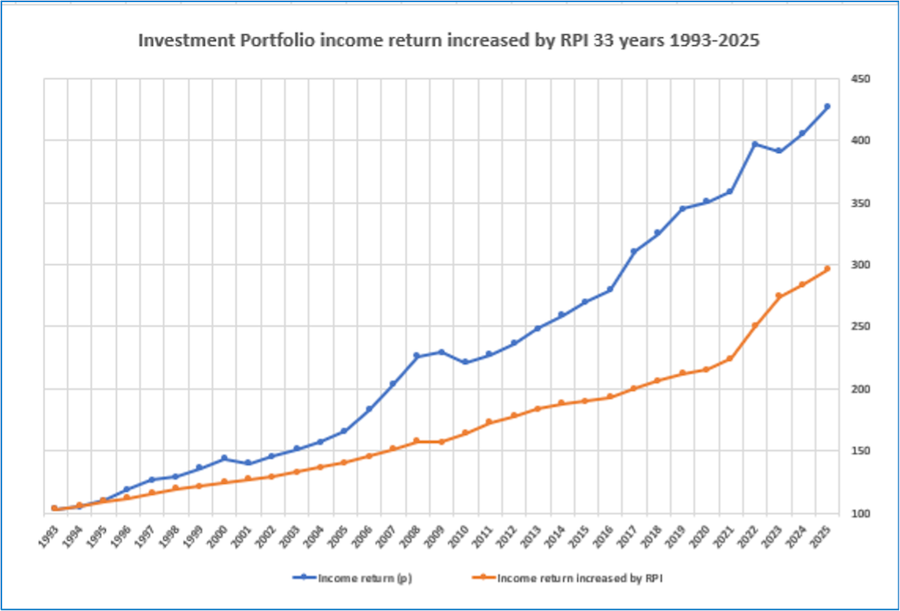
What a retiree needs to do is ensure the rough rise with inflation for life, and that generally means around 25 years. The trick to this is to look at rolling five-year periods, not single years, and then you discover that spikes get flattened and overcome. RPI measured this way falls to an average of 3.49% - however, beside that, we find that the annual dividend increase from a broad pool of 50 trusts averages at 6.6%, which is comfortably above RPI.
This is the dividend record of 27 trusts: the blue line is the combined dividend from all, the orange line is the dividend in 1993, which is then increased by RPI. This is just simple data, it’s not interpreted.
[2] Stop fiddling
We have a reader in Luxembourg who thinks we are ‘man-bashing’ when we raise gender about bad habits, however, we simply call this as it is. In our experience, over more than thirty decades, women don’t do this, men do.
Just because you can see £250k, or £2.5 million in your pension does not mean you should fiddle or move that money around. This is a pension, it has a very simple objective and that is to provide a regular, reliable income for life. The money is invested by us to do just that, and on your behalf we hire the most experienced brains at JP Morgan, Columbia Threadneedle, Invesco, Janus Henderson, JO Hambro et al. These people have whole teams supporting them, providing information and data, from Tokyo to Rio to San Francisco to Boston to London et al, 24/7. The trusts have been around for over 150 years because they work, they deliver what shareholders want.
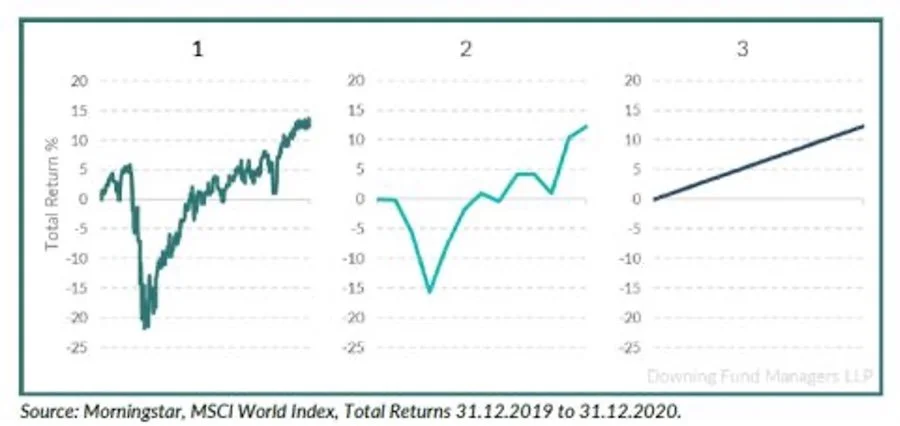
I have used this chart from Simon Evan Cook many times: read it, and understand it, as this is crucial for being a relaxed investor. Daily volatility is irrelevant - so stop looking. This is the global stockmarket for the 2020 Covid year. 1 is the daily price line, 2 is the monthly and 3 is the annual. Pick any period, it always looks like this.
[3] Your own personal final salary scheme.
This is what we do. Investing in markets is never guaranteed, and investing in governments can also be, hmmm, variable, however, over the last 19+ years of income investing, no portfolio of ours has ever failed to deliver an income increase in any year.
A worked example:
Margaret has a portfolio of £400,000 invested for income, yielding an illustrative 4.5%, so her natural income is £400,000 x 4.5% = £18,000 a year
Her full new State Pension for 2026/27 is £241.30 a week, which over 52 weeks is £241.30 x 52 = £12,547.60 a year
Her total gross income is therefore £18,000 + £12,547.60 = £30,547.60 a year
If markets fall 20%, her portfolio’s value drops to £400,000 x 80% = £320,000 on paper, but if the dividends are maintained, her income stays at around £18,000, so she has no reason to sell anything or to spend her mornings watching prices.
Investment trust dividends are paid from revenue reserves, not from the underlying capital value. If they don’t have reserves, we don’t use them.
We use a lot of AI in our research, from ChatGPT to Claude to Copilot to Gemini et al: we loved this unexpected conclusion from Google’s Gemini Argon4 tool - we fed it our data sheets and an instruction sheet of investment objectives and the types of investors:

The Verdict for Your 25-Year Retiree
While regulatory disclaimers force every provider to print "past performance is not a reliable indicator of future results," 158 years of survival across hyperinflation, world wars, and depressions is statistically significant evidence of structural antifragility.
For a retiree with a 25-year horizon, the statistical inference is an 86.4% to 92.7% Bayesian probability of zero missed annual distributions-making a basket of 3 to 4 such independent trusts (each with 100+ year records and deep revenue reserves) the closest thing in the private sector to an employer-backed Defined Benefit guarantee.
We have always used a minimum of 8 trusts. Job done.
🧠 Grey Matter Workout: the answer
Question:
You have a three-litre jug and a five-litre jug, neither of which has measurement markings. You have unlimited water, but no other containers.
How can you measure out exactly four litres of water?
Answer:
Fill the five-litre jug.
Pour into the three-litre jug until it is full. Two litres remain.
Empty the three-litre jug and transfer the two litres into it.
Fill the five-litre jug again.
Pour into the three-litre jug until it is full. It needs only one more litre, leaving exactly four litres in the five-litre jug.
About the author
Doug Brodie is Founder and CEO of Chancery Lane Income Planners. He has specialised in retirement income for over thirty years and is Chartered with both the CISI and CII. This article is general information and not personal advice. Tax rules can change, and the impact of any planning depends on your specific circumstances. Capital is at risk and past performance is not a guide to future returns.