
Pensions Made Reliable & The Great DB/DC Divide

by Doug Brodie
There is a glaring blind spot at the heart of UK pension policymaking: almost all senior politicians, civil servants, and established pension-industry decision-makers hold Defined Benefit (DB) pensions.
Because their own retirement income arrives automatically on the 28th of every month - indexed to inflation and underwritten by the taxpayer or a FTSE 100 balance sheet - they have a completely warped perspective on what a "good" pension looks like for the rest of us holding Defined Contribution (DC) pots.
To a DB scheme member, a pension is a guaranteed salary backed by an employer’s blank cheque. If global markets crash, or gilt yields spike, or life expectancy jumps, the employer simply writes a larger cheque to plug the actuarial deficit.
If you have a DC pot (a SIPP or workplace personal pension), you are the actuary, the investment manager, and the guarantor.
The Fallacy of "Total Return" Guessing
Mainstream wealth managers usually tell DC retirees to rely on "Total Return", selling down units of capital each year to fund their lifestyle while trying to guess the next twelve months' asset allocation. When markets drop 15%, selling units to buy groceries locks in permanent capital destruction.
The Alternative: Natural Income
True reliability in a DC world comes from separating your Capital Base from your Income Stream. By structuring a portfolio around Natural Income, sustainable dividends from global and UK equities, coupled with reliable coupon payments from bonds and infrastructure, your lifestyle is funded by the cash yield generated by the underlying assets, leaving the capital base untouched to recover from market cycles. Regular readers know that in the early 2010’s almost all our income work was in fixed income stocks and funds, however, QE stymied that market and since 2012/3 we have been chiefly with investment trusts due to their balance sheet reserve structures.
The Verdict for a 25-Year Retirement
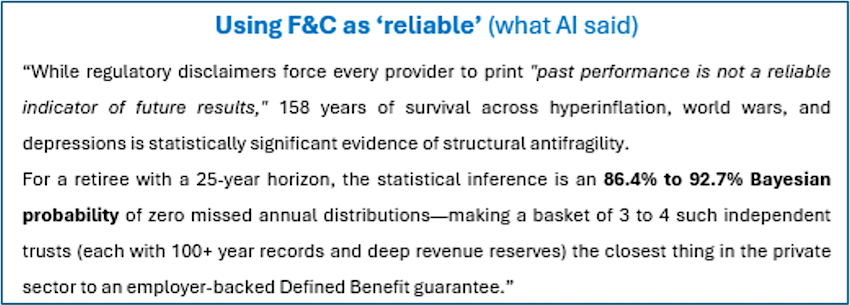
While regulatory disclaimers force every provider to print "past performance is not a reliable indicator of future results", 158 years (F&C) of survival across hyperinflation, world wars, and depressions is statistically significant evidence of structural antifragility.
For a retiree with a 25-year horizon, the statistical inference is an 86.4% to 92.7% Bayesian probability of zero missed annual distributions, making a basket of 3 to 4 such independent trusts (each with 100+ year records and deep revenue reserves) the closest thing in the private sector to an employer-backed Defined Benefit guarantee.
[1] The data doesn’t lie - from the DWP Horse’s Mouth
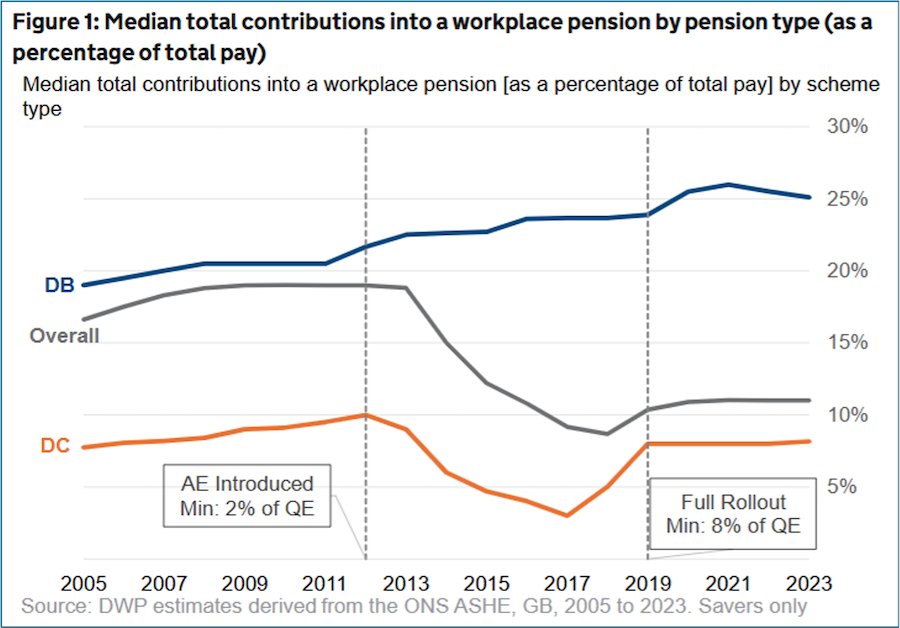
Why do DC retirees have to work so much harder to build a £40,000 annual income than DB members? The Department for Work and Pensions (DWP) release, Analysis of Automatic Enrolment saving levels, lays the disparity bare.
As the report highlights, while Automatic Enrolment brought over 22 million people into workplace saving, a massive gulf exists between those in legacy/public DB schemes and private-sector DC savers.
Figure 1: Median Total Contributions into a Workplace Pension by Pension Type (as a % of total pay, 2023)
(Source: DWP Analysis of Automatic Enrolment saving levels / ONS ASHE Data)
According to Figure 1 of the DWP statistics, the median total contribution into a Defined Benefit scheme is 25% of total pay, compared to just 8% of total pay in a Defined Contribution scheme (split roughly 4% employer, 4% employee). Over half (53%) of all private-sector DC savers are stuck saving at or below 8% of total pay.
[2] The worked example: the lifetime treasury ledger on tax & pensions
Hold the Treasury to their own rhetoric. Politicians and civil servants routinely justify bringing Defined Contribution (DC) pensions into the 40% Inheritance Tax (IHT) net by claiming that pensions enjoy "generous upfront tax reliefs" that were never meant for wealth transfer.
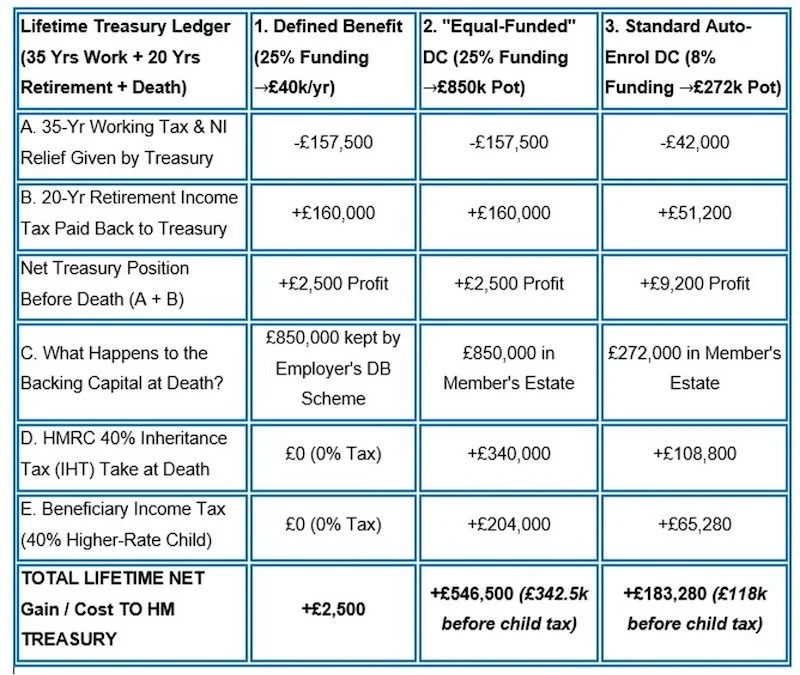
Follow the money from the first day of a 35-year career on a £50,000 constant real salary right through 20 years of retirement to the day the member dies at age 85.
To make the comparison crystal clear, we look at three peers on £50,000 a year:
Member 1 (The DB Member): Receives the DWP Figure 1 median 25% contribution (20% employer / £10,000 p.a. + 5% employee / £2,500 p.a. = £12,500/yr).
Member 2 (The "Equal-Funded" DC Member): Receives the exact same 25% contribution as the DB member (20% employer / £10,000 p.a. + 5% employee / £2,500 p.a. = £12,500/yr). Over 35 years at ~4.1% real return, £12,500/yr compounds into the £850,000 capital base needed to pay £40,000/yr in retirement.
Member 3 (The Average Auto-Enrolment DC Member): Receives the DWP Figure 1 median 8% contribution (4% employer / £2,000 p.a. + 4% employee / £2,000 p.a. = £4,000/yr). Over 35 years at ~4.1% real return, £4,000/yr compounds into just £272,000, paying a natural income (at 4.7% yield) of only £12,800/yr.
This gets worse: when a DC member like you and I die, Rachel Reeves, the current Entrepreneurship Advisor to the Treasury, decided that instead of remaining in a discretionary trust, it should fall into our taxable estate and be charged IHT at 40% (over the threshold, obvs). Final salary schemes are not charged IHT, personal pensions are: here is the maths comparing ifs and buts of an employer funding the same 25% into a DB scheme and a personal pension.
Both personally and professionally, I think this idea from a former Chancellor has the same level of thought and due diligence as the Truss/Kwarteng budget. The chances of this surviving in this format until the time when you and I die are - hmmm - slim.
[3] £850k - leave it for IHT or draw it down for gifts out of income?
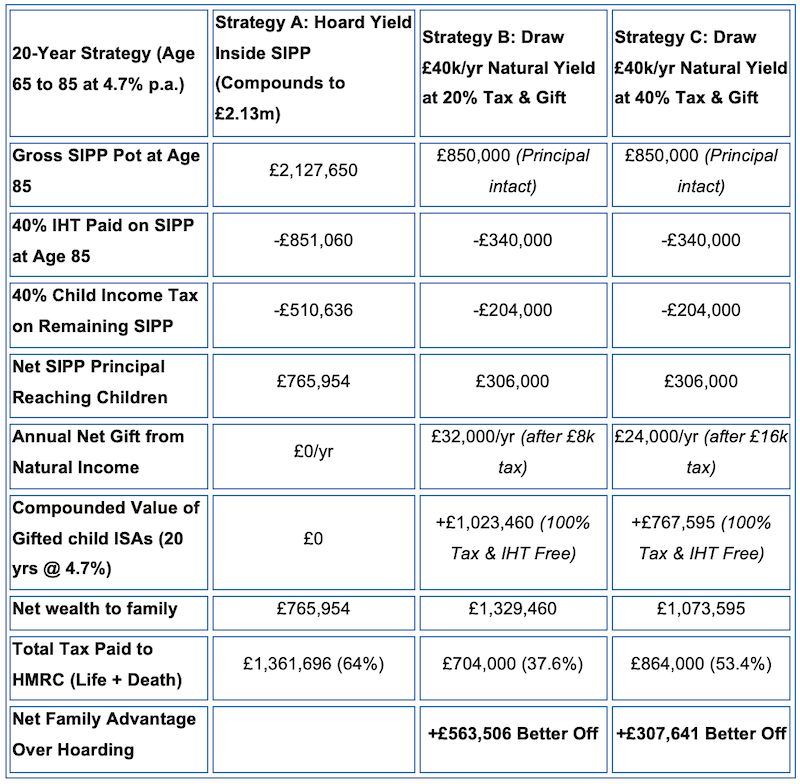
The Baseline Comparison: Hoarding vs. Gifting the Natural Income Yield
Suppose your £850,000 pot earns 4.7% (£40,000/year). Let's compare what happens over 20 years if you reinvest/hoard that £40,000 inside the SIPP versus drawing the £40,000 natural income every year, paying your marginal Income Tax, and gifting the net cash into your children's ISAs (where it compounds at the same 4.7% completely tax-free).
(Assumptions: Your £500k/£1m IHT nil-rate bands are already absorbed by your home; death occurs after age 75; and your adult children are 40% higher-rate taxpayers).
Going all the way: What if you need the £40k to live on, so you draw down the £850k principal to gift?
What if you actually spend the £40,000 natural income yourself to fund your own lifestyle?
If you stop there, you leave the £850,000 principal sitting in the SIPP at age 85, where HMRC takes £340,000 in IHT and £204,000 in beneficiary income tax, leaving your children just £306,000.
Instead, suppose you increase your regular annual pension drawdown to extract the £850,000 principal over 20 years alongside your living income, classifying the scheduled excess drawdown as regular pension income to fund annual gifts:
If extracted within the 20% Basic Rate band (e.g., splitting pots across a married couple or phasing before State Pension / higher thresholds): You pay £170,000 in lifetime income tax, and £680,000 (plus up to 20 years of tax-free ISA compounding in your children's hands) reaches your family, beating the £306,000 left-in-SIPP outcome by £374,000+.
If extracted at the 40% Higher Rate band: You pay £340,000 in lifetime income tax, and £510,000 (plus tax-free compounding in your children's hands) reaches your family, beating the £306,000 left-in-SIPP outcome by £204,000+.
Beware this is easier said than done, given that we don’t know how long we need our income to last.
[4] Why "Normal Expenditure Out of Income" Beats Every Other Route
Zero 7-Year Clock: Unlike lump-sum capital transfers (Potentially Exempt Transfers), gifts made from regular pension income are exempt from the 40% IHT charge on Day One. Even if you pass away in Year 3 of retirement, every single pound already gifted is 100% outside your estate.
Eliminates the "Tax-on-Tax" Cascade: When money dies inside a SIPP after age 75, HMRC applies a double tax, being IHT and then income tax on the beneficiary (1 - 0.60 × 0.60 = 64%). When you draw out during life and gift under Section 21, you pay a single tax (20% or 40% Income Tax) and zero IHT.
Compounding happens in a tax-free wrapper: every £1,000 of investment growth that happens inside your SIPP after age 65 is eventually taxed at 40% to 64% on death (leaving perhaps £360 for your children). Every £1,000 of investment growth that happens after you gift that income into your adult children’s Stocks & Shares ISAs or Junior ISAs is taxed at 0% (leaving the full £1,000 for your family).
🧠 Grey Matter Workout: the answer
Riddle:
If you throw me from the window,
I will leave a grieving wife.
Bring me back in the door and
you'll see someone giving life.
What am I?
Answer: The letter ‘N’
Window becomes widow
Door becomes donor
About the author
Doug Brodie is Founder and CEO of Chancery Lane Income Planners. He has specialised in retirement income for over thirty years and is Chartered with both the CISI and CII. This article is general information and not personal advice. Tax rules can change, and the impact of any planning depends on your specific circumstances. Capital is at risk and past performance is not a guide to future returns.