
Ms Monroe’s holiday reading


by Doug Brodie
Ok, I confess, the books here weren’t even written when Marilyn had this photo taken, yet every summer someone asks us what to read on holiday that is not a thriller with a submarine on the cover.
Here are five books that between them explain most of what we believe about money and retirement income. They are not ‘heavy’ (well, not every page), you can dip in and out of them, and they are very informative. Charlie was a director of Vanguard, Wade has a PhD in financial planning, Morgan has sold 12 million books in 60 languages and Moshe is an academician in finance, maths and statistics – you’ll love them all!
[1] Winning the Loser's Game - Charles Ellis
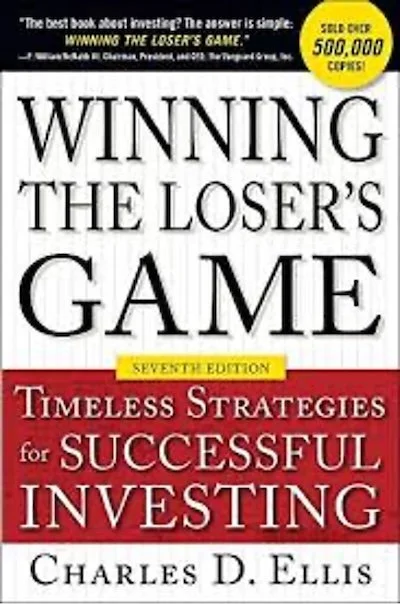
Ellis borrowed his big idea from an essay on amateur tennis. Professionals win points with brilliant shots; amateurs lose them with unforced errors, so the amateur who simply keeps the ball in play wins. Investing, Ellis argues, has become the same. When he started out in the 1960s, markets were mostly private individuals, and a well-resourced professional could beat them.
Today the market is overwhelmingly institutions trading against each other - the professionals ARE the market, so in trying to beat it, they are trying to beat themselves, after costs. That arithmetic turns active investing into a loser's game, and the way to win a loser's game is to stop making mistakes. His prescription is disarmingly simple. Decide your long-term policy based on who you are, what the money is for and when you will need it. Write it down. Then hold on through the frightening bits, because the real risk is not the fall in prices but your reaction to it.
Ellis spent a career advising the world's biggest institutions, which makes his conclusion all the more striking: the client's behaviour, not the fund manager's skill, decides the outcome. Still the most elegant case for patience we know.
[2] The Psychology of Money - Morgan Housel
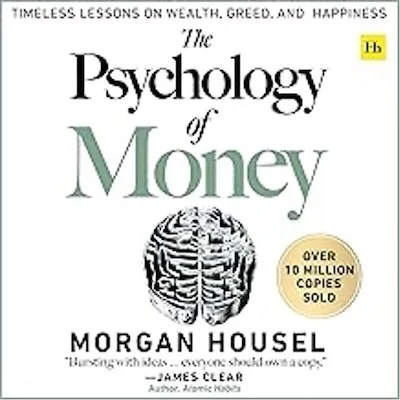
Housel's premise is that doing well with money has remarkably little to do with intelligence and almost everything to do with behaviour, which is why brilliant people go broke and a janitor called Ronald Read quietly left $8 million to his local library and hospital.
The book is nineteen short chapters, each built around a story. Compounding gets the best one: the great fortunes come not from spectacular returns but from ordinary returns sustained for an extraordinarily long time - the bulk of Warren Buffett's wealth arrived after normal retirement age, because he started at ten and never stopped.
Other chapters cover why 'enough' is the most valuable word in finance, why wealth is what you don't see - the cars not bought, the money left invested - and why saving needs no reason beyond the freedom it buys. His most useful distinction for retired readers is between being rational and being reasonable. The mathematically optimal plan is worthless if you abandon it in the first bear market; the plan you can sleep with is the one that works.
No formulas, no jargon, nothing to calculate. Short, warm and wise. We give copies to clients' adult children, and occasionally to clients.
[3] Retirement Planning Guidebook - Wade Pfau
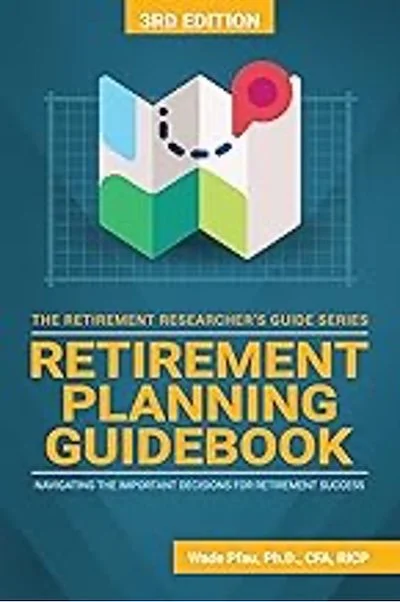
Pfau is the American professor who did the sums the retirement industry preferred to skip, including the awkward finding that the famous 4% withdrawal rule rested on one country's unusually lucky century of stock market data. His guidebook is a doorstop - the current edition runs to more than 500 pages - and covers the whole retirement landscape: sequencing risk, annuities, long-term care, housing, tax and the psychology of spending after a lifetime of saving.
Two ideas matter most.
First, his retirement income styles framework, which starts from the sensible observation that there is no single right answer, only the answer that fits your temperament.
Second, the distinction that runs through all his work: probability-based versus safety-first. The probability-based investor keeps everything in a portfolio and hopes the markets cooperate for thirty years. The safety-first investor secures the essential income before anything else, then invests the remainder with a clear conscience.
Regular readers will know which camp we sit in, and our own research at chancerylane.net points the same way. The tax and product chapters are thoroughly American - IRAs and Roth conversions are no use to you - but the thinking on turning a pot into a lifelong income crosses the Atlantic intact.
[4] How Not to Invest - Barry Ritholtz
Most investment books tell you what to do. Ritholtz - money manager, columnist and host of the Masters in Business interviews - spent decades collecting what people actually did, then wrote the anti-manual. The book organises the damage into three piles: bad ideas, bad numbers and bad behaviour.
Bad ideas include the eternal parade of confident forecasters, who are rarely punished for being wrong and never remembered for it either.
Bad numbers cover the statistics manufactured to alarm you - headlines built to frighten you into action, precision that dissolves on inspection.
Bad behaviour is the most expensive pile of all: panic selling at the bottom, chasing last year's winner, and the itch to do something when doing nothing pays better.
His conclusion lands exactly where Ellis landed fifty years earlier - avoiding unforced errors matters far more than the occasional stroke of genius, because one big mistake can undo twenty years of compounding. Ritholtz is funny and blunt, and the book is full of stories about clever people doing daft things with serious money, including a few of his own. You will recognise someone in these pages. Possibly yourself.
One caveat: it is written for American readers, so translate the products before applying the lessons.
[5] Pensionize Your Nest Egg - Moshe Milevsky and Alexandra MacQueen
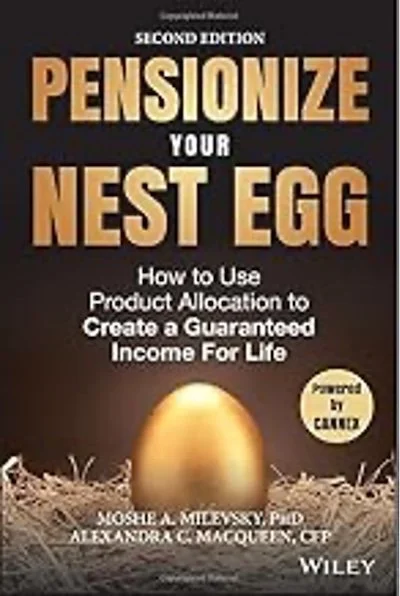
The book that gave us a verb we wish the industry used daily. Milevsky, a finance professor who has spent his career on the mathematics of retirement income, and MacQueen argue that a pot of money is not a pension. A pension is income that arrives every month for as long as you live, however long that turns out to be - and if your employer no longer provides one, you must build your own.
The villain of the book is longevity risk: you know roughly what markets might do, but you have no idea whether you are funding a fifteen year retirement or a thirty five year one, and no investment portfolio on its own can insure you against outliving it.
Their answer is what they call product allocation, as distinct from asset allocation - deciding how much of your wealth should sit in guaranteed lifetime income and how much in invested assets, so the essentials are covered whatever markets do and however long you live. They even offer a Retirement Sustainability Quotient to score how secure your plan really is.
Written for Canadians, but the principle is universal, and it is precisely the thinking behind the income portfolios we build here. If you only read one book on this list, make it this.
About the author
Doug Brodie is Founder and CEO of Chancery Lane Income Planners. He has specialised in retirement income for over thirty years and is Chartered with both the CISI and CII. This article is general information and not personal advice. Tax rules can change, and the impact of any planning depends on your specific circumstances. Capital is at risk and past performance is not a guide to future returns.