
On ‘yer bike


by Doug Brodie
[1] I've saved all my life, so why does spending it feel so wrong?
Most of us spent forty years being told that the sensible thing to do with money was to put it away, so it is hardly surprising that the habit refuses to switch off on the day the last payslip arrives. I hear it often, usually in a slightly guilty tone, from people who have a perfectly good pension and still feel uneasy about booking the cruise or replacing the car that has rattled through three winters.
Part of the difficulty is that a pension pot looks like one large number, and watching a large number get smaller feels like failure, even though spending it is exactly what the money was saved for. An income that arrives on the same day each month feels very different, because it behaves like the salary we were used to and quietly gives us permission to spend what comes in.
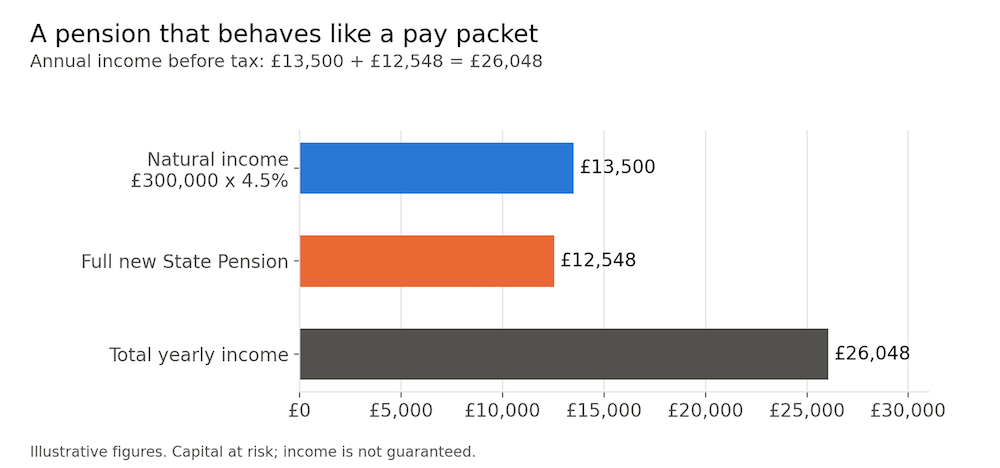
Take someone with a £300,000 pension invested for natural income at an illustrative yield of 4.5%, alongside a full new State Pension of £12,548 a year. The pension produces £13,500 a year (£300,000 x 4.5%), and adding the State Pension brings total income to £26,048 a year before tax (£13,500 + £12,548).
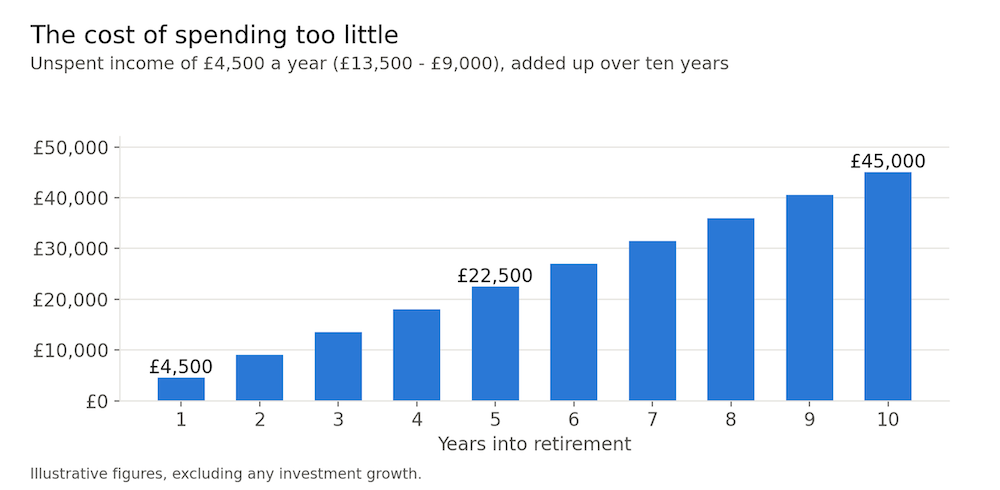
Now suppose nerves mean they spend only £9,000 of that natural income each year. The unspent £4,500 (£13,500 minus £9,000) builds up to £45,000 over ten years (£4,500 x 10), before any growth, and that is money which could have paid for time with the grandchildren, travel while they are fit enough to enjoy it, or simply a more comfortable life.
Spending the income while leaving the capital invested is exactly what the pension was built to do, and once people see their pension as a pay packet rather than a pot to be guarded, most find they can finally relax and enjoy the money they worked so hard to put aside.
Figures are illustrative. Dividend income is not guaranteed and the value of investments can fall as well as rise.
[2] Nobody warned me about the first Monday
Most people plan the money side of retirement with great care, yet give far less thought to how they will fill the days, which is surprising when you add up how much time is suddenly handed back. A 40-hour week over 46 working weeks comes to 1,840 hours (40 x 46), and an hour's commute each working day adds another 230 hours (1 x 5 x 46), so stopping work releases around 2,070 hours a year (1,840 + 230).
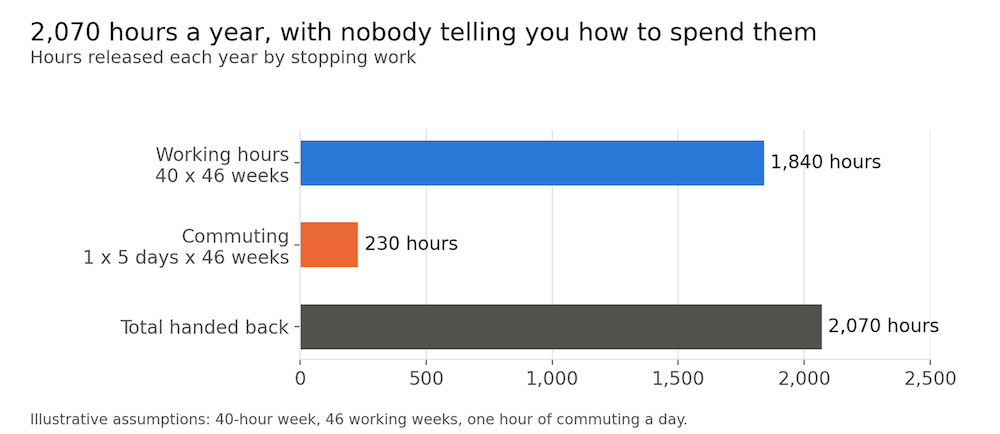
Over the first ten years of retirement, that comes to 20,700 hours (2,070 x 10), roughly the same as a decade of a full-time job, and it arrives without a manager, a timetable or colleagues to share a cup of tea with. The first few months often feel like a long holiday, filled with trips away and the jobs around the house that have waited for years, and it is usually somewhere in the second half of the first year that people notice something is missing.
What they tend to miss is less the work itself than the sense of being useful, the shape of the week and the easy company of other people. Those who settle best usually find something that brings those back, whether that is a retired engineer who now runs the local repair café, a former nurse mentoring students, or someone who keeps two days a week of consultancy because they enjoy it.
Couples face a particular adjustment when two people who spent their working lives apart are suddenly at home together all day, and a frank conversation beforehand about space, shared plans and separate interests can save a good deal of friction later. There is a money angle too, because purpose usually comes with a modest price tag in club fees, courses or travel, and setting aside £1,800 a year for it is a small cost for a much happier retirement.
[3] The bank of Mum and Dad is open, but should it be?
Wanting to help our children onto the housing ladder, or to help grandchildren through university, is one of the most natural instincts there is, and many parents would rather see the difference their money makes now than leave it to be shared out after they have gone. The worry that sits alongside that wish is a fair one, because every pound given away is a pound no longer earning income, and nobody wants to become a burden on the very children they set out to help.
A simple way to judge the trade-off is to ask how much income each gift will cost you every year. Using an illustrative income rate of 4.5%, a gift of £25,000 gives up £1,125 of income a year (£25,000 x 4.5%), £50,000 gives up £2,250 (£50,000 x 4.5%) and £100,000 gives up £4,500 (£100,000 x 4.5%). For a 40% taxpayer, each pound of that income would only have been worth 60p to spend, so the real loss of spending money is £675 (£1,125 x 60%), £1,350 (£2,250 x 60%) and £2,700 (£4,500 x 60%) a year respectively.
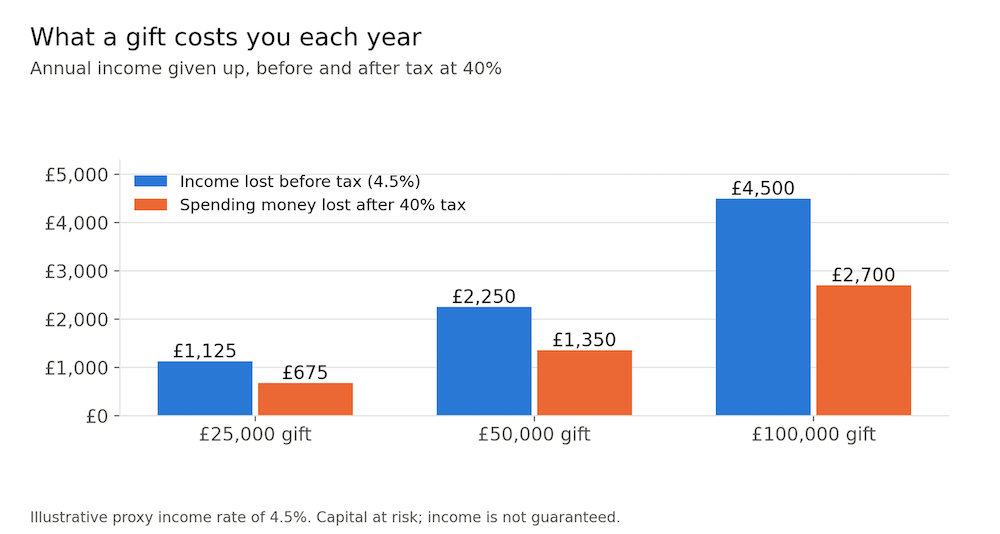
Put like that, a £50,000 deposit for a son or daughter means living on £1,350 a year less for the rest of your life, which some families will find perfectly comfortable and others will not, and seeing the figure clearly makes the family conversation far easier.
Tax also comes into it. You can give away £3,000 a year free of inheritance tax and carry one unused year forward, so £6,000 is possible in the first year, while larger gifts generally fall outside your estate once you survive them by seven years. Regular gifts made from surplus income can also be exempt, provided they do not reduce your standard of living and you keep good records. From April 2027, unused pension funds are due to be counted in your estate for inheritance tax, which is prompting many families to think about giving during their lifetime rather than later.
Fairness between siblings deserves just as much thought as tax, and writing down whether money is a gift or a loan can prevent resentment years from now, so it is worth taking advice before making larger gifts.
[4] If I go first, will they cope?
In many marriages one person looks after the pensions, the investments and the paperwork while the other has never needed to, and it is a quiet worry for a great many couples that the partner left behind may struggle to find their way through it all at the hardest possible time.
It can also last longer than people expect. As an illustrative assumption, if each partner in a couple has a 30% chance of reaching 92, the chance that at least one of them does is 1 minus (0.7 x 0.7), which works out at 1 minus 0.49, or 51%, so planning for a long period on your own is something most couples need to do.
The change in income can be sharp as well. Consider Peter and Anne, a fictional couple who each receive the full new State Pension of £12,548 a year, with Peter also drawing a workplace pension of £15,000 a year that pays half to a surviving spouse. While both are alive, the household receives £40,096 a year (£12,548 + £12,548 + £15,000). After Peter's death, Anne receives her own State Pension plus a spouse's pension of £7,500 (£15,000 x 50%), a total of £20,048 a year (£12,548 + £7,500).
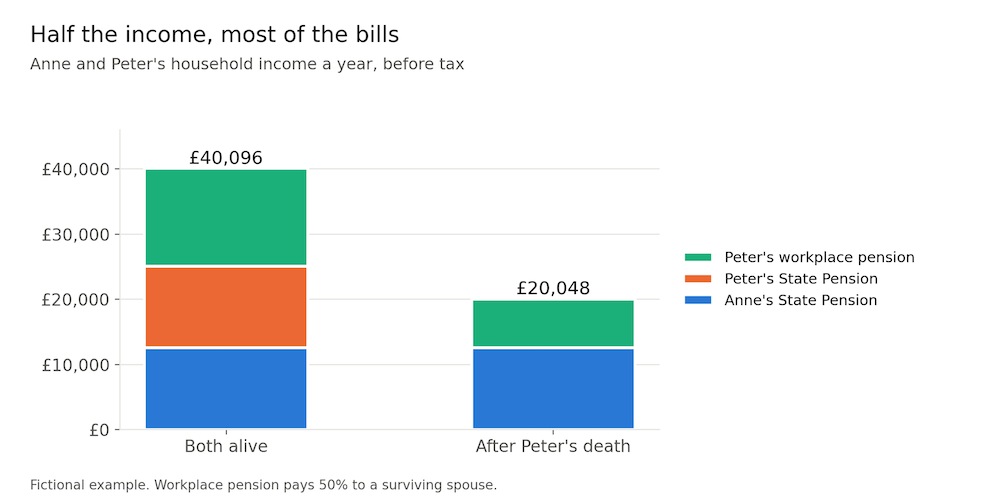
Anne's income has fallen by £20,048 (£40,096 minus £20,048), exactly half, while most of her bills stay much the same. Council tax is one of the few costs that drops, through the 25% single person discount, so a £2,200 bill falls by £550 (£2,200 x 25%) to £1,650, while energy, insurance and the cost of running the house barely move. In most cases under the new State Pension, you cannot inherit your partner's basic amount, although some people can inherit part of an additional amount, so it is worth checking with the Pension Service.
The practical steps can be completed over a few evenings, starting with a written list of every account and who to call, up-to-date wills and lasting powers of attorney, nomination forms on every pension, and a plan that shows the survivor exactly what income will continue and when.
🧠 Grey Matter Workout: the answer
Question: You are given 8 identical-looking balls, but one is heavier than the others. Using a balance scale, how do you find the heavier ball in just two weighings?
Answer:
Separate the 8 balls into two groups of 3 (let's call them Group A and Group B) and set aside a final group of 2 (Group C).
Place Group A on the left side of the scale and Group B on the right side.
If Group A and Group B balance: The heavier ball is in Group C. Weigh the 2 balls from Group C against each other; the side that goes down is the heavier ball.
If Group A and Group B do not balance: The heavier ball is in the group that went down. Take any 2 balls from that heavier group of 3 and weigh them against each other. If they balance, the third unweighed ball is the heavy one. If they do not balance, the side that goes down is the heavy ball.
About the author
Doug Brodie is Founder and CEO of Chancery Lane Income Planners. He has specialised in retirement income for over thirty years and is Chartered with both the CISI and CII. This article is general information and not personal advice. Tax rules can change, and the impact of any planning depends on your specific circumstances. Natural income is not guaranteed and dividends can be reduced. Capital is at risk and past performance is not a guide to future returns.