
Super-agers: how to get to 80 with the memory of a 50-year-old.


by Doug Brodie
I keep a notepad on my desk where half-formed thoughts go to wait their turn. Every so often a page fills up and I have to do something with it, so this week five of those thoughts earned a proper outing. Two are true stories from America, one involving a great deal of money and one involving a cat. The other three are questions, and I would be grateful if you took them seriously, because we do.
Super-agers are adults over 80 whose performance on tests of episodic memory is equal to or better than that of people in their 50s. The term comes from Northwestern University in Chicago, which has been studying them for more than 25 years.
In February, the New York Times reported on new research published in Nature. Scientists at the University of Illinois College of Medicine Chicago found that super-agers generate twice as many new neurons in the hippocampus, the part of the brain critical to learning and memory, as typical older adults. Their rate was higher even than that of much younger individuals. By contrast, in people experiencing cognitive decline, including those with Alzheimer's disease, new neuron production seems to falter. This is the first study to identify a genetic difference between super-agers and typical older adults.
There is a catch: the researchers examined brains donated after death, so the study shows what a super-ager's brain looks like, not how to become one. The next step is to understand what these new neurons actually do.
The earlier Northwestern work does offer a clue. Super-agers don't share the same diet, medication or exercise routine, but they do share a love of socialising. Read all you like, everywhere you read, you’ll see commentary that socialising is key for our longevity and for keeping our marbles intact.
This week, put one regular social commitment in the diary: a team sport, a running group, a choir, a walking group or a standing lunch. Treat it like a pension contribution.
[1] Heads I win, tails you lose
In July 2009, Andrew Cuomo, then Attorney General of New York, published a report into the 2008 bonuses paid by the first nine banks to receive rescue money under the US Government’s Troubled Asset Relief Program, known as TARP. The report’s own phrase for what it found was a “heads I win, tails you lose” bonus culture.

The numbers are worth reading slowly:
Across the nine banks, nearly 4,800 people received bonuses of $1 million or more for 2008.
Citigroup, which received $45 billion of government money and guarantees, paid 738 of its people at least $1 million each, in a year when it lost $18.7 billion.
Merrill Lynch paid 696 bonuses of at least $1 million, in a year when it lost more than $27 billion.
Goldman Sachs earned $2.3 billion in 2008 and paid out $4.8 billion in bonuses, more than double its profit.
It would be easy to cast the bankers as pantomime villains. The more useful lesson is duller and more practical: people do what they are paid to do. The bonus systems rewarded activity and revenue, and kept doing so even when the results turned catastrophic. Cuomo’s point was that pay and performance had come apart, and nobody inside the system had much reason to put them back together.
So here is the Saturday question for your own pension. Between your money and your monthly income, who gets paid, how much, and would any of them be paid more if you did something that was not in your interest? Here in the UK, an FCA-regulated adviser has to set out the costs and charges for you, in pounds as well as percentages. If you have never read that page on your own plan, it is a good use of ten minutes. Ours are on the website under ‘Our fees and charges’, because we think you should know before you ask.
[2] The $20 million cat
Some time in the mid-1960s, the CIA’s technical people had a problem. Soviet officials had a habit of holding sensitive conversations outdoors, on park benches, where a fixed microphone could not reach them. Someone asked what could wander up to a park bench without anyone giving it a second glance. The answer was a cat.

The project became known as Acoustic Kitty. According to accounts that emerged later, a microphone was placed in the cat’s ear canal, a transmitter at the base of its skull, and an antenna was woven through its fur and along its tail. Victor Marchetti, a former CIA officer, later put the cost at about $20 million, although that figure does not appear in the released CIA papers.
The technology, by most accounts, more or less worked. The cat did not. It got hungry, it got distracted and it wandered off, as cats do. The CIA reportedly went back for further surgery to deal with the hunger. They were nothing if not committed.
The ending depends on who you ask. Marchetti said that on its first real outing, near the Soviet compound in Washington, the cat was released from a van and promptly run over by a taxi. (Aaaargh!!) Robert Wallace, who later ran the CIA’s Office of Technical Service, disputed this and said the equipment was removed and the cat lived out a long and happy life. What is not in dispute is that a declassified CIA memo from 1967 concluded that trained cats were not practical for intelligence work, and the project was dropped.
I love this story because every retirement plan has a cat in it somewhere. The plan works beautifully on paper, right up until it depends on something behaving the way the plan needs it to. Markets that rise on schedule. Interest rates that stay put. A retiree who never panics and never sells at the bottom. The most expensive equipment in the world will not make a cat walk in a straight line, and the cleverest projection will not make markets, or people, behave on command. A good plan starts from how things actually behave, which brings me to the third question.
[3] Correct, or understood?
My industry has built some very correct things: stochastic projections, Monte Carlo simulations, sustainable withdrawal rates with an 85% or 90% probability of success. The maths can be perfectly sound. Our own 2025 White Paper, Retire Well, which you can request free from chancerylane.net, spends a whole section comparing deterministic and stochastic projections, so I am not dismissing it.
But try asking a 72-year-old what an 85% probability of success means for them, at three in the morning, after the markets have dropped 20% in a month. Does it mean they are 85% fine? That 15% of the time the money runs out? That it runs out 15% early? In my experience, almost nobody who has been shown that number can tell you what it means a week later.
The regulator has taken a view on this too. Since July 2023, the FCA’s Consumer Duty has required firms to communicate in a way that customers can actually understand. Understanding is now a regulatory outcome in its own right.
My own answer to the question is that ‘understood’ comes first, for a very practical reason: a plan you understand is a plan in which you can spot the mistakes. A correct plan you do not understand is one you will abandon the first time it frightens you, and an abandoned plan is no longer correct.
Here is what that looks like in pounds and pence. Meet Geoff and Sandra, 68 and 66, with £400,000 invested in drawdown. They could have their income explained to them in two ways.
Explanation A: “Your portfolio is targeting a sustainable withdrawal rate of 4%, calibrated to an 85% probability of success over a 30-year horizon, with units encashed across the asset allocation to fund each payment.”
Explanation B: “Your investments pay out dividends and interest of about £16,000 a year. That is what you live on. We do not sell anything to pay you.”
The arithmetic behind Explanation B, using an illustrative natural yield of 4% (a yield assumption, not a forecast or a promise):
Annual income: £400,000 × 4% = £16,000
Monthly income: £16,000 ÷ 12 = £1,333.33
Now look at what happens under Explanation A when the market falls by 20%. Suppose Geoff and Sandra hold 400,000 units, each priced at £1.00, and they need £16,000 for the year.
Normal year: £16,000 ÷ £1.00 = 16,000 units sold
After a 20% fall, the unit price is £1.00 × 0.80 = £0.80
Units sold to raise the same £16,000: £16,000 ÷ £0.80 = 20,000 units
Extra units sold: 20,000 − 16,000 = 4,000, which is 4,000 ÷ 16,000 = 25% more units than in a normal year
Portfolio value after the fall: 400,000 units × £0.80 = £320,000, so the withdrawal is now £16,000 ÷ £320,000 = 5.0% of what is left
Geoff and Sandra’s £16,000, in a normal year and after a fall
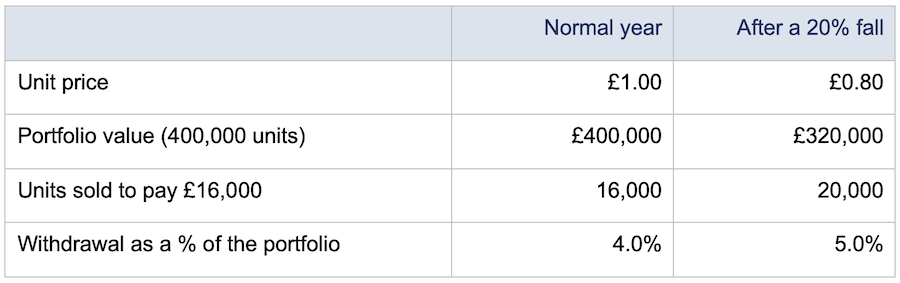
Those 4,000 extra units are gone for good. When the market recovers, they are not there to recover with it. Under Explanation B, Geoff and Sandra sell nothing in the fall, and the question they are left asking is whether the dividends and interest keep arriving, which is a much easier question to watch and to understand.
Natural income is not guaranteed either. Dividends can be cut, and many were in 2020. Some investment trusts hold back part of their income in good years, in what are called revenue reserves, so they can keep paying in lean ones, but even that has limits. Capital is at risk whichever way you do it. The difference is that Geoff and Sandra can see the thing that matters: the income arriving. They can explain it to each other over breakfast. To me, that is what being understood looks like.
[4] What would perfect look like?
Most people can describe a perfect holiday in some detail: the weather, the view, the length of the lunch. Ask the same people to describe a perfect retirement and the answer tends to go vague. Comfortable. Not worrying. Seeing the grandchildren. All good things, none of them things you can plan against.
We touched on this in ‘What were you thinking?’ on 28 August, with the question of what the money is actually for. This week I want to push it one step further: perfect needs a number next to it.
When Geoff and Sandra sat down with a pad of paper, their perfect retirement turned out to be quite specific: two holidays a year, Wednesdays with the grandchildren, the car replaced every seven years or so, and never having to think twice about the heating. They worked out that all of that costs about £40,000 a year between them, before tax.
Now the arithmetic. I am assuming both of them receive the full new State Pension, which for 2026-27 is £241.30 a week.
State Pension each: £241.30 × 52 weeks = £12,547.60 a year
State Pension for both: £12,547.60 × 2 = £25,095.20 a year
Gap to perfect: £40,000 − £25,095.20 = £14,904.80 a year
Natural income from their £400,000 (from section 3): £16,000 a year
Margin: £16,000 − £14,904.80 = £1,095.20 a year
Capital needed to produce the gap at a 4% yield: £14,904.80 ÷ 0.04 = £372,620
So perfect, for Geoff and Sandra, costs £372,620 of their £400,000. The remaining £27,380 is their margin for the boiler, the roof and the unexpected. Perfect is affordable, with a little to spare. They had spent three years worrying about it without ever writing the number down.
These figures are before tax, and what each of them pays depends on their own circumstances. The State Pension rises every April under the triple lock, while growth in natural income may follow over time but is not guaranteed. The exact figure is not really the point. Once ‘perfect’ has a number, it stops being a feeling and becomes something you can plan for.
The pad of paper also tends to reveal that the most important parts of perfect cost nothing at all. Health, purpose, people you like, those deserve the top line on the page.
[5] The unbucket list
A bucket list is everything you want to do before you go. Lovely idea, and I have one. But I have come to think the unbucket list is the more powerful of the two: the things you are determined NOT to do. ‘Bucket lists’ tend to be talked about more by youngsters desperate to get off the working treadmill. By the time most of us reach retirement, we have already done many of those things.
Ask people what perfect looks like and they hesitate. Ask them what they want to avoid and the answer usually comes back in seconds, and with feeling. In our experience, the answers cluster around a handful of things:
I do not want to run out of money before I run out of life.
I do not want to be a burden on my children.
I do not want to check the stock market every morning before I have had my coffee.
I do not want to be bored. We wrote about the boredom nobody warns you about in ‘Other people’, on 2 July.
I do not want to leave a pension pot that ends up largely with HMRC. After our Hotel California piece in May, a lot of you added this one: from 6 April 2027, most unused pension funds come inside the Inheritance Tax estate.
My own unbucket item? No domestic chores, shopping or fixing things at weekends. I want my Saturdays back!
Each of those tells you something useful about how your retirement plan should be built. If you do not want to check the market every morning, you want an income that does not depend on selling at the right price. If you do not want to be a burden, you want a plan for care and a Lasting Power of Attorney in place while it is easy to arrange. If you do not want HMRC to be your largest beneficiary, the order in which you spend your money needs looking at before April.
So here is the homework, and it takes less time than the crossword. Write down the one thing you most want to NOT do in retirement. One line. Put it on the fridge. If you are married, do it separately and then compare notes, because the answers are often different and that conversation is worth having. Then bring the piece of paper with you when we meet.
So, five things
Nearly 4,800 bankers paid handsomely, whatever happened. A cat that did as it pleased, at great public expense. And three questions only you can answer: whether you understand your plan, what perfect would cost, and what you are determined to avoid.
The first two are someone else’s problem. The last three are yours, and they are the ones we spend most of our time on in an Income Discovery Meeting. If any of them made you put your cup down, good. The question landed. It’s good to talk.
Book a no-obligation Income Discovery Meeting
020 7390 0670
Two hours, both of you, no jargon, no pitch. We bring the coffee.
You bring the questions, your pension statements and, this week, the piece of paper from the fridge.
🧠 Grey Matter Workout: the answer
Question: What goes up and down at the exact same time, yet never moves?
Answer: a staircase.
About the author
Doug Brodie is Founder and CEO of Chancery Lane Income Planners. He has specialised in retirement income for over thirty years and is Chartered with both the CISI and CII. This article is general information and not personal advice. Tax rules can change, and the impact of any planning depends on your specific circumstances. Natural income is not guaranteed and dividends can be reduced. Capital is at risk and past performance is not a guide to future returns.