
Three stories (and a maths lesson)

by Doug Brodie
[1] The chauffeur who gave the lecture

Charlie Munger, Warren Buffett’s business partner for more than fifty years, told this story to the graduating law students at USC in 2007. He was careful to call it apocryphal. I shall be careful too.
Max Planck, having won the Nobel Prize, toured Germany giving the same lecture on the new quantum mechanics. His chauffeur sat through it so many times that he learned the whole thing by heart. Eventually he asked:
“Would you mind, Professor Planck, because it is so boring to stay in our routine, if I gave the lecture in Munich and you just sat in front wearing my chauffeur’s hat?”
Planck said, “Why not?”
The chauffeur delivered the entire lecture. Then a physics professor stood up and asked (in Munger’s words) a perfectly awkward, technical question. The chauffeur considered it and replied: “Well, I am surprised that in an advanced city like Munich I get such an elementary question. I am going to ask my chauffeur to reply.”
Munger told it to make a point about knowledge rather than about quick wits. There are two kinds of knowledge in the world, he said.
Planck knowledge belongs to the people who really know, who have paid the dues, done their own research, the hard grind and they have the aptitude.
Chauffeur knowledge belongs to the people who have learned to talk the talk. They “may have a big head of hair. They often have a fine timbre in their voices. They make a big impression.” And what they have is chauffeur knowledge masquerading as real knowledge. A veneer that can’t cope with scratching on the surface.
Then Charlie’s warning, “You’re going to have the problem in your life of getting as much responsibility as you can to the people with the Planck knowledge and away from the people who have the chauffeur knowledge. And there are huge forces working against you.”
I have spent more than thirty years in retirement income, and I can confirm that the huge forces are in excellent health in financial services. Our industry is very good at fine timbre. It is fluent in the language of portfolios, volatility and long-term averages, and a good deal of that fluency is memorised rather than understood.
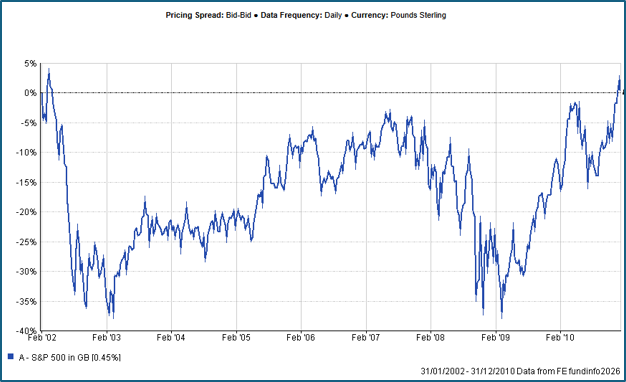
So, a practical suggestion for the next time you sit across a desk from anyone discussing money: ask a second question. Then ask a third. Planck knowledge gets clearer under follow-up questions. Chauffeur knowledge reaches for the brochure. The worst time for DIY investors happens to be about now: with an annualised return on the S&P of 13% over the least 10 years being 13%, and last year being over 20%, honesty disappears out the window when you ask if that will continue this year, next, next …
They don’t think the following chart would apply to them: nine years nil return from the S&P:
[2] “You are never too old to make a good deal”

Madame Jeanne Calment, still smoking in her second century.
Madame Jeanne Calment was born in Arles on 21 February 1875 and died on 4 August 1997, aged 122 years and 164 days. She remains the longest-lived human being in recorded history, and the record is not a close-run thing.
People have long wondered what her secret was. You would not have designed it in a laboratory. She smoked until she was around 117. She was fond of chocolate, reportedly about a kilogram of it a week. She rounded off the day with a glass of something. She cycled until her hundredth birthday, lived on her own from the age of 88, and only moved into a nursing home shortly before she turned 110.
Marc Middleton of Growing Bolder puts it down to what the French call joie de vivre, which on the evidence is as good an explanation as any of the medical ones. She took up fencing in her eighties and kept her independence for another twenty years.
And then there is the property deal, which I think about more often than is probably healthy.
In 1965, when Jeanne was 90, a local lawyer named André-François Raffray, then 47, offered to buy her flat. They agreed a viager, a French arrangement whose name means “for life”. The buyer pays the seller a fixed sum every month for as long as the seller lives, and takes the property when the seller dies.
Raffray believed he had found the deal of a lifetime. A 90-year-old woman who smoked and drank daily, already two decades past normal life expectancy, and a valuable flat in a desirable corner of southern France. He agreed to pay 2,500 francs a month, reported at the time as roughly 500 dollars.
He paid it for thirty years.
Raffray died on Christmas Day 1995, aged 77. By then he had handed over something in the region of $184,000, which contemporary reports put at more than twice the flat’s market value. His widow was legally obliged to keep sending the cheque, and did so for roughly another nineteen months, until Jeanne finally died in August 1997.
Asked about the arrangement, Jeanne is said to have raised her glass and toasted: “You are never too old to make a good deal.”
I enjoy that story enormously, and it is also the clearest illustration I know of the risk we spend our working lives helping clients manage. Monsieur Raffray’s error had nothing to do with property values. His error was confidence about timescale, and lifespans refuse to cooperate, precisely the bet you make every time you look at a pension pot and ask whether it will last.
It is why we build income plans around natural income, meaning the dividends, coupons and rents that the underlying investments actually pay out, in preference to a total return figure and a withdrawal rate. Natural income keeps arriving whether you live to 82 or to 122. A pot that is being steadily sold down has an end date, and none of us is told the date we are planning towards. There is more on the arithmetic of this in the research dotted around our website.
[3] Twelve miles a day at ninety-one

On the first day of summer, just after dawn, Dale Sanders, 91, prepared to start the steep, rocky climb up to Franconia Ridge in New Hampshire’s White Mountains.
His mantra will resonate with anyone in their tenth decade.
“It’s a ‘don’t fall’ day today,” he said, slinging on a small backpack.
The Appalachian Trail runs roughly 2,190 miles from Georgia to Maine. Mr Sanders set off from Harpers Ferry in September 2025 and has been chipping away at it ever since, aiming to walk the entire length inside a twelve-month period and reclaim his record as the oldest person to complete a thru-hike. He is averaging around twelve to thirteen miles a day with one rest day a week. At the time of writing he has the final stretch of Maine left, including the 100-Mile Wilderness.
He is no novice. He retired in 2002 after a career in parks and recreation for the US Navy, marked his 80th birthday by becoming the oldest person to paddle the full length of the Mississippi, and finished the Appalachian Trail at 82 in 2017. In 2021 a hiker named M.J. Eberhart, trail name ‘Nimblewill Nomad’, took the record from him by completing it at 83.
Sanders befriended Eberhart, encouraged him to go for the record, and then walked the closing days of the attempt alongside him to keep him going. “He was going to quit several times,” Sanders said. “I actually went up and hiked with him the last few days so that he wouldn’t quit. We’re really close friends.” Eberhart is now helping with the logistics of the very attempt that will take the record back off him.
Sanders traces his competitive streak to being bullied at school on a Kentucky tobacco farm, and to the escape he found in sport. “I wasn’t good in the books,” he said. Physical activity, on the other hand, “gave me something real.”
The planning point is a short one. Ninety-one years old, twelve miles a day, a year on the trail. It is a useful corrective to the idea that retirement is a slow decline to be funded as cheaply as possible. A great many of the clients I meet have stopped spending long before their bodies asked them to. If your health is going to hold, your income needs to hold too, and it needs to be arranged so that spending it feels safe rather than reckless.
So, three stories and a maths lesson
Ask harder questions of anyone advising you, decline to bet against your own longevity, and spend some of it while you can still get up Franconia Ridge.
If any of that has landed somewhere near home, the conversation costs you nothing.
And the answer you didn't know you needed
And the answer to the question in my email that you didn’t know you needed is that Shredded Wheat was invented in 1890 and Marmite in 1902.
About the author
Doug Brodie is Founder and CEO of Chancery Lane Income Planners. He has specialised in retirement income for over thirty years and is Chartered with both the CISI and CII. This article is general information and not personal advice. Tax rules can change, and the impact of any planning depends on your specific circumstances. Capital is at risk and past performance is not a guide to future returns.