
What were you thinking?

by Doug Brodie
[1] The best question in investing, asked two years too late
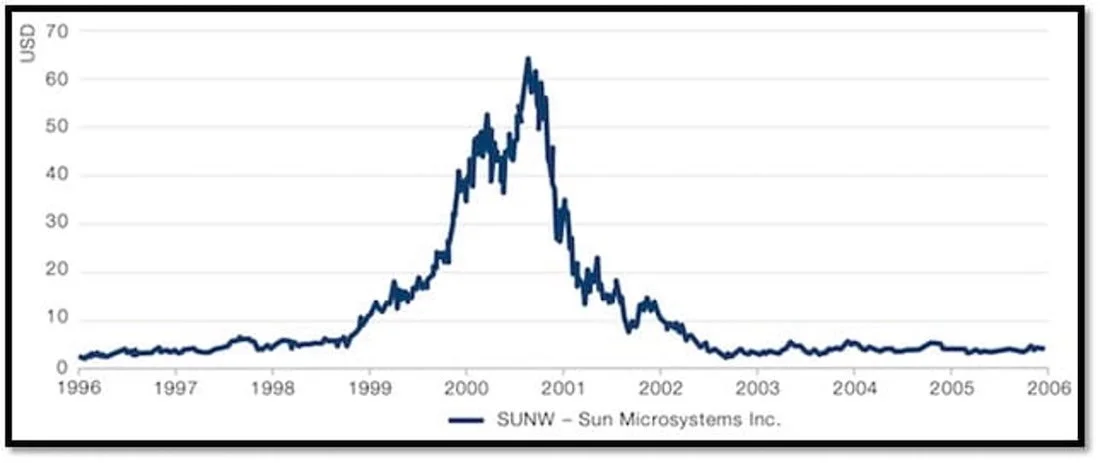
Scott McNealy co-founded Sun Microsystems and ran it as chief executive for twenty-two years. In 2000 Sun was one of the great names of the technology boom. It sold the servers that the internet was being built on, and the market could not get enough of it. The shares peaked at around $64, valuing the company at roughly ten times its annual sales.
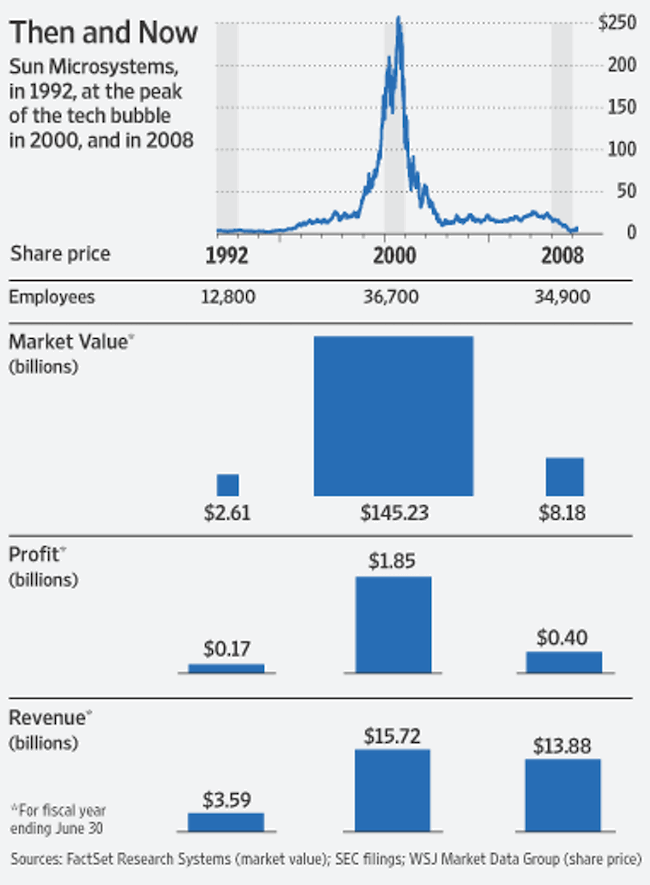
Within two years, the shares had fallen by around 95 per cent. In an interview with BusinessWeek in 2002, McNealy said this: I have never read a better paragraph on valuation, and it is worth reading slowly.

At 10 times revenues, to give you (an investor) a 10-year payback (of your money), I have to pay you 100% of revenues for 10 straight years in dividends. That assumes I can get that by my shareholders. That assumes I have zero cost of goods sold, which is very hard for a computer company. That assumes zero expenses, which is really hard with 39,000 employees. That assumes I pay no taxes, which is very hard. And that assumes you pay no taxes on your dividends, which is kind of illegal. And that assumes with zero R&D for the next 10 years, I can maintain the current revenue run rate. Now, having done that, would any of you like to buy my stock at $64? Do you realize how ridiculous those basic assumptions are? You don’t need any transparency. You don’t need any footnotes. What were you thinking?
What he is doing there is arithmetic out loud, and every step of it is checkable at the kitchen table.
Step one. You pay ten times the company’s annual sales.
Step two. For that money to come back to you over ten years in dividends, the company must hand you its entire annual sales, every year, for ten years.
Step three. To hand you its entire sales, it must have no cost of goods, pay no wages, pay no tax, and spend nothing on research.
Step four. You must also pay no tax on the dividends.
Step five. Every one of those five conditions is impossible, and several are illegal.
The conclusion is not a matter of opinion or forecasting. Ten times sales cannot be justified by the arithmetic of dividends. It can only be justified by the belief that somebody else will pay eleven times.
Nobody asked McNealy’s question in 1999. Everybody asked it in 2002. That gap, between when the question was available and when it was actually asked, is where investors lose their money.
[2] So where are we now?
Here are the seven largest companies in the American market, on the same measure McNealy was talking about. Market value divided by the sales of the last twelve months. Figures as at 25 August 2026.
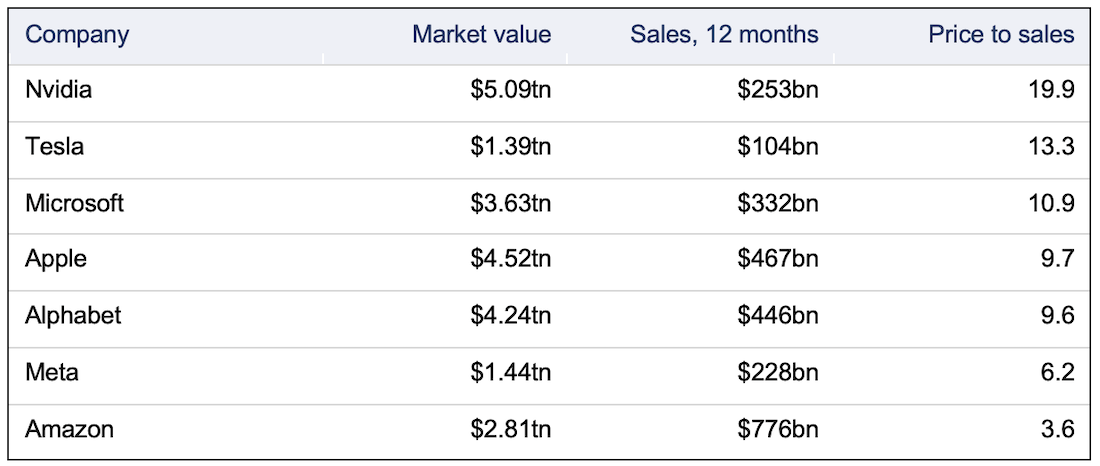
Three of the seven are above the multiple McNealy called ridiculous, and two more are within a whisker of it. Nvidia is at very nearly double it. These are, to be fair, far better businesses than Sun ever was, with profit margins Sun could only dream about. That is a real argument and I do not dismiss it. It is also the argument that was made in 1999, about companies that were, at the time, genuinely magnificent.
Now the index itself, which is what most of you actually own. The whole American market is currently valued at 3.58 times its annual sales, as at 24 August 2026. Over the full recorded history of that measure, the average has been 2.54, and the median, which is less distorted by the last decade, has been 1.65.
So what has to happen for that to come back to normal? The sum is short.
Price to sales is market value divided by sales. Hold sales still, and the only thing that can move the ratio is the price.
To go from 3.58 back to the long run average of 2.54, the price has to be multiplied by 2.54 divided by 3.58, which is 0.709. That is a fall of 29.1 per cent. Call it 29 per cent.
To go back to the long run median of 1.65, the price has to be multiplied by 1.65 divided by 3.58, which is 0.461. That is a fall of 53.9 per cent. Call it 54 per cent.
Two honest caveats though as I am not in the business of frightening people with half a calculation. Sales do not in fact stand still, they grow, so some of that adjustment can arrive through years of flat prices and rising revenues rather than through a crash. And valuations have been above average for most of the last fifteen years without anything terrible happening, which is precisely why nobody wants to hear this. The real reassuring point, though, is that you have watched the dotcom and credit crunch crashes live and you know the markets always just bounce back. Lastly – through both of those market collapses, the investment trust portfolios did not cut, they used the strengths of their balance sheet reserves not just to pay out income, but to increase the dividend payments to shareholders even though share prices were being trashed. Remember, the share price is controlled by the stock market traders every minute of the day, the dividends are controlled by the board itself, and only set four times per year.
The direction of travel is not in doubt. Every step up from here is a step nearer the correction, and it makes the correction, when it comes, a longer way down - not a forecast, it’s a simple description of what a ratio is.
[3] What this has to do with your income
You may reasonably feel that American technology shares are somebody else’s problem but they’re not. Those seven companies are around 34 per cent of the American index, and the American market is the great majority of any global tracker or typical multi-asset fund. If you hold a global equity fund, a sizeable slice of your retirement is sitting in that table. If you hold an S&P tracker, it will take you up and then back down.
I cannot tell you when the correction comes and people who say otherwise are selling something. Timescale is what Goldman Sachs, JP Morgan and all the hedge funds don’t know. What we do know is the two things in your retirement plan you actually control:
You do not control the price.
You do control whether your income depends on selling shares at that price.
This is the whole case for building retirement income out of natural income, the dividends, coupons and rents the investments actually pay you, in preference to selling units to manufacture a withdrawal. If markets fall 30 per cent and your income arrives regardless, the fall is unpleasant and survivable. If markets fall 30 per cent and you are selling units every month to pay the bills, you are crystallising the loss at the worst possible moment and permanently reducing the pot that has to fund the next twenty years.
You can’t ignore investment trusts when building rational, reliable equity income. UK dividends fell 44 per cent in 2020 on Link Group’s figures, from £110.6 billion to £61.9 billion, and two-thirds of companies cut or cancelled a payment. That was a genuine shock and anyone who tells you income never falls has not been paying attention. The point is a narrower one. Income fell for a year and recovered, and throughout it nobody was forced to sell an asset at the bottom to eat. The difference between those two positions is measured, over a full retirement, in hundreds of thousands of pounds, but not for investment trusts who don’t cut, who use reserves to smooth the hiccups – that’s why we use them. There is more on the arithmetic of it in the research on chancerylane.net – it’s simple data.
[4] So, what were you thinking of?
It is a question that almost always gets asked afterwards, in the past tense, by somebody who already knows the answer. Its entire value lies in asking it beforehand, while it is still a planning question rather than a post-mortem.
Ronald Nelissen asked it about his working life and rearranged the year to suit the answer. Scott McNealy asked it about his own company’s share price, out loud, in print, and was ignored for two years until it stopped mattering.
Ask it of your own plan while there is still time to answer it calmly. If your income for the next twenty years depends on shares staying where they are, that is worth knowing this morning rather than in the middle of it.
[5] What the pension is actually for:
I have spent more than thirty years asking people about money, and I have noticed something uncomfortable about the way our profession opens the conversation.
We ask how much you have. We ask what you earn, what you have saved, what the house is worth and whether the pensions are in one place or seven. All sensible questions, and all of them questions about the resource rather than the purpose. We rarely ask what a Tuesday in March is going to look like when you are 71.
The research on what actually makes retirement good is fairly clear, and it is worth reading before you spend another evening staring at a projection. This article sets out what that research says, then does the arithmetic on what it costs in Britain to reach the point where money stops being the problem.
One thing first, because I would rather you heard it from me. Almost all of the good survey work on retirement fulfilment is American or Canadian. I have flagged the provenance of every figure below, and I have anchored the money in British sources, because North American retirees face a different healthcare system and a different tax code. The findings on health, purpose and relationships travel well across the Atlantic. The financial context does not.
1. What retirees actually say they value
Start with the most recent large survey, the Transamerica Institute asked 2,690 American retirees about their life priorities in the autumn of 2024. Enjoying life came top at 70 per cent. Being healthy and fit came second at 67 per cent. Focusing on family came in at 32 per cent, and financial planning at 22 per cent.
Read those last two numbers again. Fewer than a quarter of retirees name financial planning as a top life priority, which is a slightly bruising finding for those of us who do it for a living! It is also, I think, the correct answer. Financial planning is a means and nobody sensible makes it an end.
The Bank of America Merrill Lynch and Age Wave study of 3,694 American adults, published in 2015, mapped seven life priorities in retirement: health, home, family, work, giving, finances and leisure. Eighty-one per cent named health as the single most important ingredient of a happy retirement. That research is now eleven years old, which I mention because you should always know the vintage of a statistic.
The most striking figure comes from the Edward Jones and Age Wave “four pillars” work, which frames retirement around health, family, purpose and finances. In their Canadian report, 97 per cent of retirees said health matters more than wealth for living well in retirement. Among those aged 75 and over, the figure was 99 per cent. We agree. I think everyone we work with agrees.
Ninety-nine per cent. In survey research you almost never see a number like that. It is the closest thing to unanimity that social science produces, and it comes from the people furthest along the road.
2. The three things that make a retirement good
Underneath the survey headlines, the same three pillars keep appearing. None of them is money.
Relationships
Professor Michael Finke examined spending patterns against life satisfaction in a survey of 20,000 retirees and found that the category with the highest correlation to life satisfaction was social spending. Money spent on being with other people bought more happiness than money spent on anything else.
That deserves a moment. It means the lunches, the golf subscription, the train fares to see the grandchildren, the holiday with old friends that costs more than the holiday on your own, are the highest-returning expenditure in your retirement. They are also, in my experience, the first things clients cut when they get nervous about the pot.
There is a British counterpoint worth knowing, and it is a reassuring one. Researchers using the English Longitudinal Study of Ageing followed 3,758 people aged 50 and over between 2008 and 2017 and found no association at all between retiring and becoming lonely, in either the short or the long term. Newly retired people actually showed a modest short-term reduction in social isolation. The fear that stopping work will leave you friendless is not borne out by the English data. What matters is what you replace the office with.
Health
Good health and regular physical activity are consistently associated with higher life satisfaction and lower rates of depression in retirement. This is the least surprising finding in the whole literature and the one people act on least.
The planning implication is not that we can sell you health. It is that health is the asset with the shortest useful life. The pension will still be there at 85. The knees that get you to Franconia Ridge will not necessarily be. If there is an argument for front-loading your retirement spending into your sixties and early seventies, this is it, and it is a better argument than any of the tax ones.
Purpose
Around 79 per cent of retirees report a strong sense of purpose. The ones who struggle tend to be those who have not managed the loss of professional identity, which arrives on a Monday morning about six weeks in, when the leaving cards have come down and nobody needs anything from you.
The research also finds that retirees who take up activities for their own sake, for the interest and the accomplishment, report higher satisfaction than those chasing an external reward. Learning the cello badly beats a part-time job you took for the money. Volunteering that uses what you are actually good at beats volunteering that fills the diary.
3. What “enough” costs in Britain, in pounds and pence
So money is not what makes retirement good. It does, however, do one enormously important job: it removes the worry. Below a certain income, financial anxiety poisons everything else on the list. Above it, more money adds remarkably little.
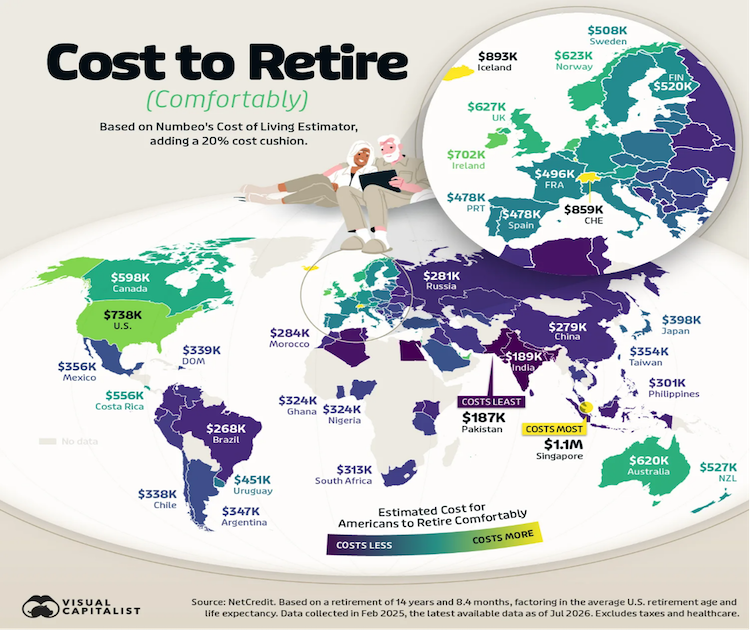
The obvious question is where that line sits. Here is the arithmetic for a couple, using British numbers.
The Pensions and Lifetime Savings Association publishes Retirement Living Standards, built from research with members of the public about what a given lifestyle actually costs. For a two-person household the latest published figures are £21,600 a year for the Minimum standard, £43,900 for Moderate and £60,600 for Comfortable. These are spending figures, so they are after tax.
Now the State Pension. In the 2026-27 tax year, the full new State Pension is £241.30 a week. £241.30 multiplied by 52 equals £12,547.60 a year.
The personal allowance is £12,570 and stays frozen there until 2030-31. So the full new State Pension sits £22.40 below the allowance, and for someone with no other income it arrives untaxed. That will not last, but it is true this year (at least until October 28th).
A couple with two full new State Pensions therefore receive £25,095.20, and pay no tax on it and that sum comfortably exceeds the Minimum standard of £21,600. A couple with full State Pension entitlement and no private provision at all is, on the PLSA definition, already above the minimum. That is not a comfortable life, but it is not destitution either, and it is worth knowing before anyone frightens you.
For the higher standards, the private pensions have to fill the gap, and that income is taxable, because both personal allowances have been used up by the State Pension. Each partner still has £37,700 of basic rate band, so the gap is taxed at 20 per cent.
Take the Comfortable standard (which is more relevant to our readership). The couple need to spend £60,600 and already have £25,095.20, so the shortfall is £35,504.80 of after-tax money. To net £35,504.80 after 20 per cent tax, you must draw £35,504.80 divided by 0.8, which is £44,381. The tax on that is £8,876.20, leaving exactly £35,504.80. Split between two people, that is £22,190.50 each, well within the basic rate band.
And the pot required to produce £44,381 a year depends entirely on the yield of what you own.
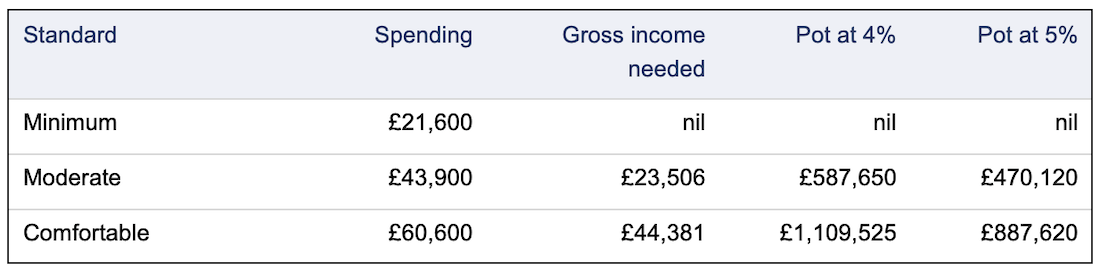
Couple, both with the full new State Pension and no other income. England, Wales and Northern Ireland tax rates. Ignores ISAs, tax-free cash and any inflation-linking of the income. Illustrative only.
So the honest answer to “How much is enough?” for a couple wanting the Comfortable standard is somewhere between £890,000 and £1.11 million of private pension, depending on what the portfolio yields.
“A single percentage point on the yield moves the required pot by more than £220,000, which is why the question of how your money produces income matters at least as much as how much of it there is.”
[6] The awkward question this raises
Put the two halves of this blog together and something uncomfortable falls out.
The research says fulfilment comes from health, relationships and purpose, and that money matters chiefly as the removal of worry. The arithmetic says the removal of worry has a price, and for most couples that price is a number they can work out in an afternoon.
This means that once you are past it, every additional pound in the pension is buying you options rather than happiness. And a great many of the people I meet are well past it, and still behaving as though they are not.
This is where I think our profession has done people a quiet disservice. We have been so good at building the number that we have let clients believe the number is the point. Then they arrive in their seventies with a larger pot than they need, a smaller social life than they had at work, and a set of habits built around accumulation that nobody has ever given them permission to reverse.
Two practical consequences follow, and they are the reason we work the way we do.
The first is that security beats performance. Retirees consistently say they value trust, transparency and simplicity above aggressive returns, and their real worries are inflation, health costs and care. A portfolio built to pay a reliable natural income, meaning the dividends, coupons and rents the holdings actually pay out, answers that worry directly. A pot that has to be sold down to produce an income does not, because its ability to pay you depends on what the market feels like on the day you need the money. There is more on the arithmetic of this in the research on chancerylane.net.
The second is that a reliable income is what gives people permission to spend. This sounds soft and it is the most practical thing in this article. When the money arrives every month, whether or not markets have fallen, clients spend it. When it has to be raised by selling something, they hesitate, and the lunches and the train fares and the holiday with old friends quietly stop happening. Which, if Professor Finke is right, is precisely the spending that was buying the happiness.
[7] So, what is the money actually for?
It is for removing a specific worry, so that the things which genuinely make a retirement good have room to happen. That is the whole job. It is a smaller job than the industry pretends and a more important one than most people realise.
Let me tell you the secret though, that comes not from surveys or economists’ musings or The Daily Telegraph, but from talking with retirees for over 30 years – you arrive at your retirement with a well-exercised, executed and controlled cost of living. You know that cost, pretty much, it is normally just under the amount you have been taking home every month. This is not rocket science. When you retire, you are already living comfortably – well, guess what, you are already up to speed on what that costs; you don’t need any clickbait headlines.
The secret part of the secret is that for most people you catch up with places not visited, but then settle down to slightly lower spending than when you were working. Commuting and 40 hours as a wage earner, you made sure you had treats and pleasures to offset that: retired? Don’t need that any more, and it’s actually quite a nice feeling being at no one’s beck and call and knowing there’s a comfortable amount of money looking after you. It’s financial independence. People who chase expensive things and experiences are usually just trying to find a purpose in life and think that money can get it; it can’t. Once you’re solvent happiness is never about money, it’s about family, mates and things to do.
Do you think these two give a hoot about someone else’s academic calculation on ‘comfortable’ retirement? No? Nor do we.

If you have never had anyone ask you what a Tuesday in March looks like when you are 71, that is the conversation we open with. It costs nothing and it is considerably more interesting than a projection.
Talk to us. It might just help.
020 7390 0670
Two hours, both spouses, no jargon, no pitch. We bring the coffee. You bring the questions.
About the author
Doug Brodie is Founder and CEO of Chancery Lane Income Planners. He has specialised in retirement income for over thirty years and is Chartered with both the CISI and CII. This email is general information and not personal advice. It is not a recommendation to buy or sell any investment. Tax rules can change, and the impact of any planning depends on your individual circumstances. Capital is at risk, income is not guaranteed and can fall, and past performance is not a guide to future returns.