

by Doug Brodie
[1] I’m 55 and I’ve had a letter saying I can take 25% of my pension pot tax-free. Should I take it?

STOP!
Well, not necessarily don’t do it. But before you fill in the form and start mentally spending the money, stop and think about what you’re actually doing.
It’s tempting. A tax-free lump sum could pay for a new car, a fantastic holiday, clear the mortgage or finally replace the kitchen. But if you’re still working and earning an income, ask yourself:
“Do I actually need this money now?”
Your pension isn’t a prize for reaching 55. It’s money you’ve spent years putting aside to provide for Future You, when you no longer have a salary coming in.
1. How long are you planning to keep working?
If you’re 55 and expect to work for another 10 years or more, your pension can remain invested during that time. Taking money now simply because you can, isn’t the same as taking it because you need it.
2. What other pensions do you have?
If this is a small pension from a job you had years ago and you have larger pension pots elsewhere, taking 25% might have relatively little effect on your overall plans. But if this forms a significant part of your total pension savings, can you really afford to take it now?
3. What are you going to use it for?
Paying off expensive debt might be a sensible reason. But if you’re simply going to put the money into savings or investments elsewhere, remember that money held within a pension already benefits from valuable tax advantages.
4. Think about how long Future You might need it.
At 55, you may feel a long way through your working life, but you could still have 20, 30 or even 40 years ahead of you. Taking 25% now means that money is no longer in your pension, potentially helping to grow and provide an income for those years.
Just because you can take it doesn’t mean you have to.
Worth knowing
With some defined contribution pensions, you do not necessarily have to take all of your tax-free cash at once. You may be able to take it in stages while the rest remains invested.
[2] What actually is a Lasting Power of Attorney?
A Lasting Power of Attorney (LPA) is a legal document that lets you appoint one or more trusted people (known as attorneys) to help make decisions, or to make decisions for you, if you’re no longer able to.
There are two types:
Property & Financial Affairs LPA
This covers things like:
bank accounts and bills
pensions and benefits
investments and property
Health & Welfare LPA
This covers things like:
medical care and treatment
your daily routine
care arrangements
life-sustaining treatment
A Health & Welfare LPA can only be used when you lack mental capacity. A registered Property & Financial Affairs LPA can, if the document allows and you agree, be used while you still have mental capacity.
Worth knowing
You must have mental capacity when you make an LPA.
[3] What can £20 a month become?
This chart shows an illustrative example of investing £20 a month in a UK index tracker fund (such as the FTSE All-Share) from 2000 to 2026.
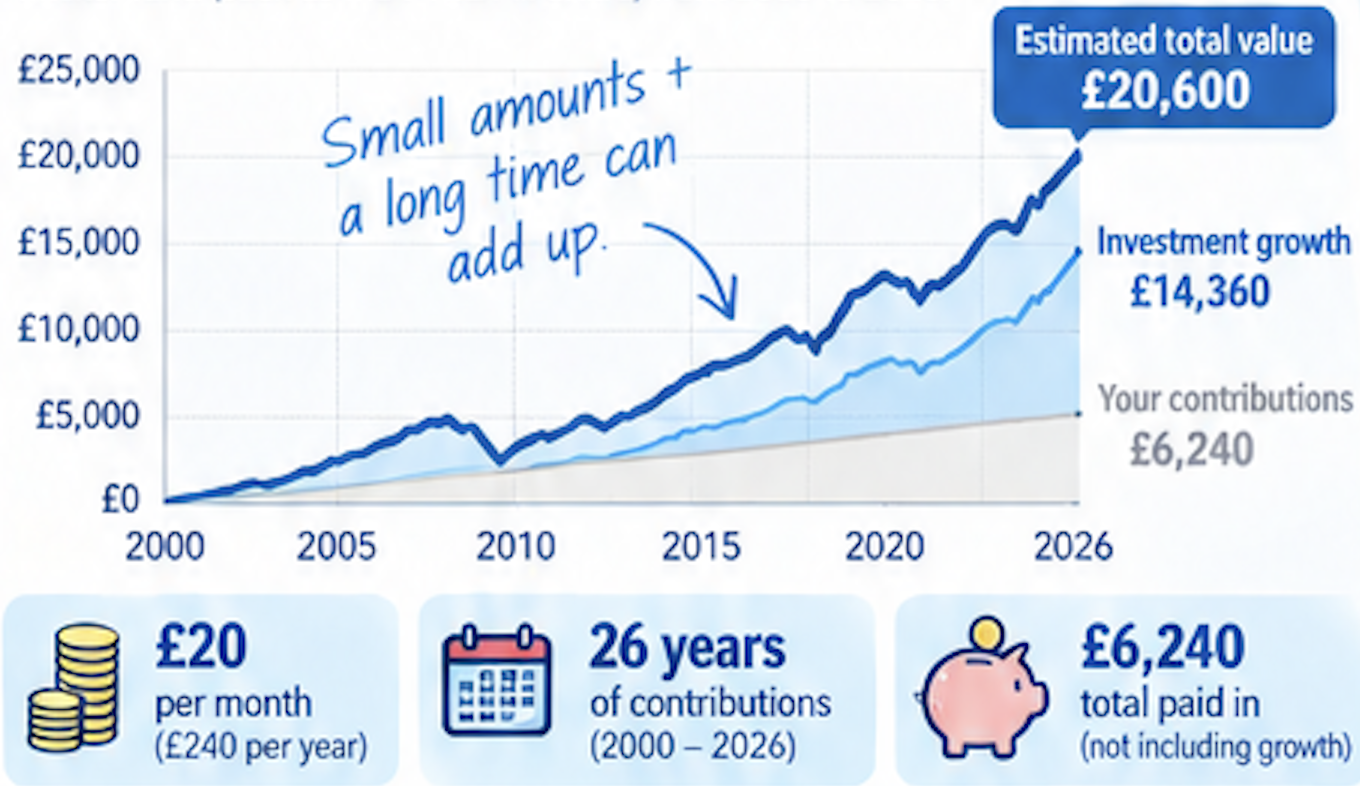
Illustrative example based on the FTSE All-Share total return (6.7% average annual return 2000–2026). Investments can fall as well as rise. Past performance does not predict future returns.
[4] True or false?
“My employer says I’m too young to join the workplace pension.”
FALSE
If you’re under 22, your employer may not have to automatically enrol you into a workplace pension. But you can usually ask to join, and your employer cannot refuse just because of your age.
Whether your employer has to contribute depends on how much you earn. They do not have to contribute if your earnings are £520 a month, £120 a week or £480 over four weeks or less.
It’s never too early to start building your future.
[5] Food for thought

The best financial decision isn’t always the one that gives you money today. It’s the one that gives you more options tomorrow.

Pension rules and tax treatment depend on your individual circumstances and may change in the future. This article is for general information only and does not constitute financial advice.