

by Doug Brodie
[1] I've just started my first full-time job. There's a pension scheme I can join, but I'm only 22. Is it really worth it?

Yes!
We know retirement feels a long way away when you're 22. There are probably more exciting things to spend your money on right now. But joining a workplace pension early can give you a real head start - and it's usually worth it.
1. Your employer puts money in too.
With a workplace pension, you're not the only one paying in. Your employer contributes too, so by joining you could be turning your money into more money straight away.
2. Your contribution may cost you less than you think.
Pensions receive tax relief, which means the amount coming out of your pay can be lower than the full contribution (see the example below).
3. At 22, you've got something incredibly valuable: time.
Money invested in your pension has decades to grow, and any growth can then generate further growth. This is known as compound growth.
4. You probably won't miss the money.
If your contributions start now, you get used to budgeting with what's left. It's often much harder to give up that money later in life.
Future You will thank you for it.
[2] What does 3% actually mean?
Let's keep it simple. Imagine you earn £25,000 a year and your employer will pay 3% of your salary if you pay 3%.
Your contribution (3%): £50.00 per month
This is what you actually pay from your salary.
Tax relief (20%): £12.50 per month
HMRC adds 20% tax relief, so a total of £62.50 goes into your pension.
Your employer (3%): £62.50 per month
Your employer also adds 3% of your salary.
Total into your pension: £125.00 per month
That's £1,500 a year going towards Future You.
Worth knowing
This example assumes contributions are based on your full £25,000 salary and the scheme operates on a relief at source basis (like a SIPP). Workplace pension schemes can work in different ways, so check your own scheme for details.
[3] Did you know?
The government paid money into a Child Trust Fund for millions of children.

Child Trust Funds were launched in 2005 for eligible children born between 1 September 2002 and 2 January 2011.
Most children received an initial £250 from the government.
Children in lower-income families could receive £500 (£250 extra).
From August 2010, the initial payment was reduced to £50 (or £100 for lower-income families).
If a parent or guardian did not open an account, HMRC opened one on the child's behalf.
The money belongs to the child and can be withdrawn at age 18.
Not sure if you have a Child Trust Fund?
You can use the free gov.uk service to find it: https://www.gov.uk/child-trust-funds/find-a-child-trust-fund
[4] Retirement could last longer than you think
Thanks to longer life expectancy, many of us could spend 20, 30 or even more years in retirement.
Average life expectancy at age 65 (UK, 2022-24)
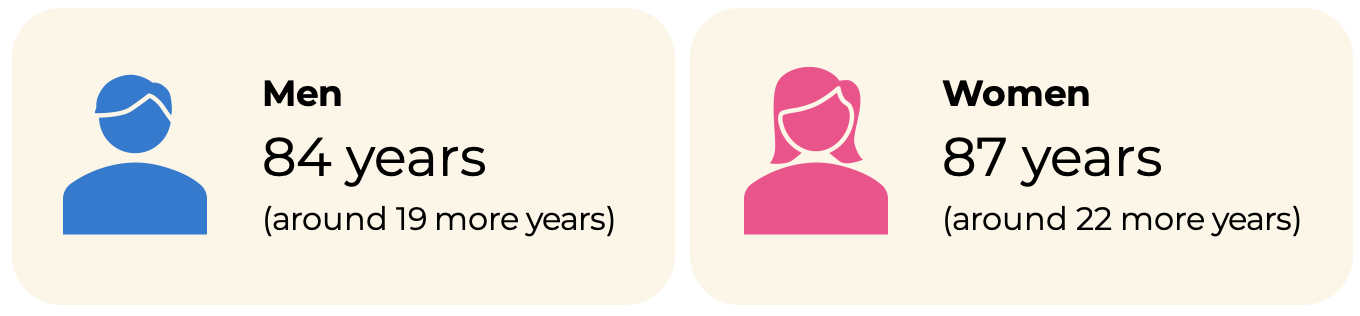
Source: Office for National Statistics. Period life expectancy at age 65, UK, 2022-24. Figures are averages and your individual life expectancy may be higher or lower.
That could be decades of travel, spending time with family, pursuing hobbies, learning new things or even working in a different way.
[5] True or false?
"Once I reach State Pension age, I have to stop working."
FALSE
Many people choose to keep working – and enjoy it!
There is no general retirement age in the UK. Reaching State Pension age means you can claim your State Pension, but it doesn't mean you have even work in a to stop working.
You can usually continue working for as long as you want, and you can choose to claim your State Pension while you're still working, or defer it to a later date, which can increase the amount you receive.
[6] Food for tought

Your finances aren't supposed to look like everyone else's.
At different stages of life, we have different incomes, responsibilities, priorities and plans. What works for one person may be completely different for another.
Good financial planning is about making your money work for the life you are actually living.