
The Grandads of Anarchy
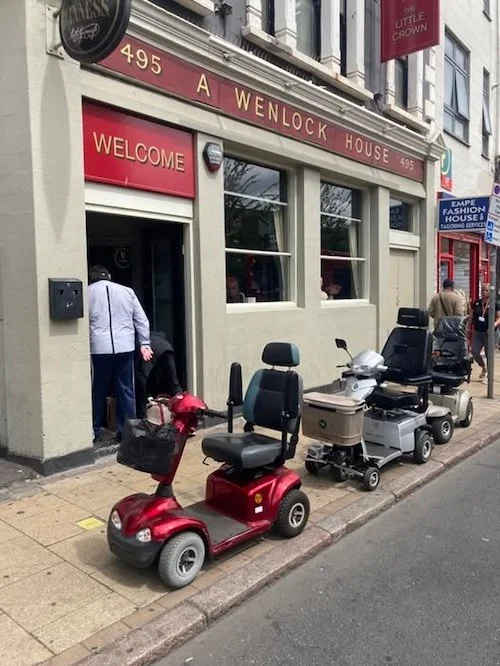
The Grandads of Anarchy: vehicles parked, pints poured, life carrying on.

by Doug Brodie
That is not a stock photo. Someone snapped it outside a pub one ordinary afternoon: three or four mobility scooters lined up at the kerb like Harley-Davidsons outside a roadhouse, their riders inside enjoying a drink. We have come to think of them as the Grandads of Anarchy. Wheels a little slower than they once were, spirit entirely intact.
We keep coming back to them because they get something right that a great many people miss. The point of money in later life is not the money. It is the pint, the company, the afternoon out. The job of a good financial plan is simply to make sure those afternoons keep happening, for as long as you want them to, without you ever having to wonder whether you can afford the next one.

There is a key difference between final salary pensions, and money purchase pensions.
In the former, you get told what your income will be in retirement, you then design your lifestyle to fit.
In the latter, people too often try to start with the lifestyle – that’s the wrong end of the telescope.
Get your income sorted before you organise your lifestyle – avoid the tears.
So this week, two things. First, plainly, how you work with us and what we actually do. Second, the three ingredients that sit underneath every investment decision we make on your behalf. And then, at the end, the part that matters most - which, frankly, is not about investing at all.
/1. How you work with us - the whole journey
New clients are often surprised by how we start. There is no pitch. The first conversation is just that: a conversation.
The Income Discovery Meeting.
We sit down together - both spouses, where there are two of you - for around two hours. No jargon, no product talk. We want to understand the shape of your life: what you have, what you spend, what you worry about at three in the morning, and what you would do with more freedom if you had it. We bring the coffee. You bring the questions and, ideally, the paperwork.
The plan.
We then build a picture of your retirement that answers the only question that really matters: can I afford the life I want, for as long as I live, whatever happens? We use a measure we have written about before, the Retirement Funded Ratio, which compares everything you have against everything you will need. It tells us - in one honest number - whether you are comfortable, stretched, or sitting on more than you will ever spend.
Hands up, we are slow; that’s very deliberate because your retirement plan will be for life, so it has to be right first time. But before you start guessing, it is also completely fluid, it changes and is ultimately flexible. Usually at outset the financial plan is very manual, whilst you get the capital, dwindling income and expenses in order and settled. The plan is the guardrails; it is the reference table for you to evaluate money and choices. It’s slow because we do it together – we can’t help manage your expectations unless you have a good handle on what to expect.
We talk a lot: we can wrap things up into an annuity if preferred and then you are free to live life on your guaranteed and fixed income forever – no choices to be made, no capital options, no changes in lifestyle to consider. Like the state pension, it’s fixed, now there’s nothing left to do.
The recommendation.
Only once the plan is clear do we talk about how the money should be arranged: which pensions, which investments, how much income, drawn in what order, and how to keep the tax bill as low as the rules allow. Everything is written down, in plain English, in a report you can actually read. Spend cash, why not, there’s no income tax to pay.
The ongoing relationship.
This is the part that does not show up in a brochure. Markets move. Tax rules change - as readers of our recent piece on pensions and Inheritance Tax will know all too well. Your life changes too. So we meet at least once a year, formally, and we are at the end of a phone the rest of the time. A plan made in 2026 and never touched again is not a plan; it is a museum piece.
We are independent and agnostic about options: we can’t do anything until clients tell us what they want – income, capital, flexibility, £4,150 per month, rising or level, to pay for the future wedding, the boat, the kids’ deposits, the parents’ last little bit of mortgage.
We currently supervise client money on eleven different platforms, and with 47 different fund managers. We run money in passive trackers with Vanguard and iShares, and cash in instant access and term deposits. Gilts, corporate bonds, pension funds and unit trusts, and, chiefly, investment trusts.
It is illegal for us to have any financial relationship with a financial provider or manager. If we recommend cash deposits held in the Isle of Man, there’s a reason; if we recommend a portfolio of investment trusts supported by cash, that’s because our 37 years of experience and our full-time research subsidiary show us the outcome data. We don’t have views, we just have results, and in our data from 1986 forwards no retirement portfolio has ever failed to increase its income in any year.
“The three big stresses in retirement are health, family and money.
What does anyone want from their pension if not income?”
Aside from the administration, research, report writing, tax calculation, software planning, that is the whole journey. Discovery, plan, recommendation, and then a long, steady relationship in which we do the worrying so that you can be out with the Grandads of Anarchy instead.

/2. The three ingredients of investing
Strip investing back to its bones and there are only three ingredients that decide how it turns out. Everything else is noise. In plain English, they are timescale, costs and returns. Let us take them one at a time, with the numbers shown.
Ingredient one: timescale.
Time is the most powerful, and most underrated, force in investing. It is what turns modest growth into meaningful wealth, through compounding - returns earning returns of their own.
A worked example. Suppose you have £100,000 invested, growing at 5 percent a year after charges. Watch what time does:
After 5 years: 100,000 x 1.05 to the power of 5 = £127,628
After 10 years: 100,000 x 1.05 to the power of 10 = £162,889
After 20 years: 100,000 x 1.05 to the power of 20 = £265,330
In the first five years you gain about £28,000. In the second decade you gain over £100,000 - from the same pot, at the same rate. That is compounding, and it is precisely why a 70-year-old with a 25-year horizon should usually still own some growth assets, rather than retreating entirely to cash. Time has not run out at retirement. For most of our clients it has barely got going.
Ingredient two: costs.
Costs are the silent passenger. They are deducted whether markets rise or fall, and over time they compound against you exactly as returns compound for you.
Take the same £100,000 over 20 years. Imagine the underlying investments grow at 6 percent a year before charges. Compare two cost levels:
Total charges of 0.75 percent a year: net growth 5.25 percent. 100,000 x 1.0525 to the power of 20 = approximately £277,000.
Total charges of 2.00 percent a year: net growth 4.00 percent. 100,000 x 1.04 to the power of 20 = approximately £219,000.
The difference - around £58,000 - went entirely on charges. Same investments, same market, same 20 years. That is why we are, frankly, obsessive about costs: about the assets we choose, the platforms we use, and the total you pay all in. A percent here or there sounds trivial. Over a retirement, it is a car, or a conservatory, or several very good holidays.
(Those growth rates are illustrative, chosen to show the mechanism rather than to predict any actual return. Real markets do not deliver a tidy fixed percentage each year, and your own figures should always be reviewed against live data.)
Ingredient three: returns.
Returns are the ingredient everyone obsesses over and, oddly, the one we can control the least. Nobody - not us, not anyone - knows what markets will do next year. What we can do is set a sensible level of risk for your circumstances, diversify properly so that no single disappointment sinks the ship, and then leave the strategy alone long enough for time and low costs to do their work.
Note: income is different – it is not correlated to capital and as such, it has shown to be projected with 94%+ accuracy over future years.
The Projected Income Pension is simple, just don’t go muck it up by confusing income with capital!
Notice the order of power, though. You cannot control returns. You can control your timescale - by not panicking out of the market at the wrong moment - and you can control your costs absolutely. Two of the three ingredients are largely in your hands. That is a more hopeful thought than most people expect.
/3. What we do that you never see
Between those annual meetings, a good deal goes on quietly in the background. You are not meant to notice most of it - that is rather the point. But you might like to know it happens.
We monitor the funds you hold and the costs you pay, and we move when something is no longer good enough. We research, read, unpick and interview, all day every day.
We watch the tax rules and the Budgets, and we tell you when something - like next April's pension changes - means your plan needs adjusting.
We rebalance, gently, so your portfolio income does not quietly fade away.
We keep an eye on the order in which you draw income, so that you pay the legal minimum of tax, not a penny more.
And we are here when life happens - a bereavement, a house move, a grandchild's school fees, a health scare - so that the plan bends to fit your life rather than the other way round.
None of this is glamorous. All of it matters. It is the financial equivalent of a well-maintained scooter: you do not think about it until the day it lets you down, and our entire job is to make sure that day never comes.
/4. The one ingredient that matters more than all of them
Here is where we put the calculator down.
This note was written on the headed paper of the Chateau Marmont, a famous old hotel on Sunset Boulevard in Los Angeles. The words are by the fashion designer Tom Ford, and we have checked the quote is genuinely his. Read it slowly.
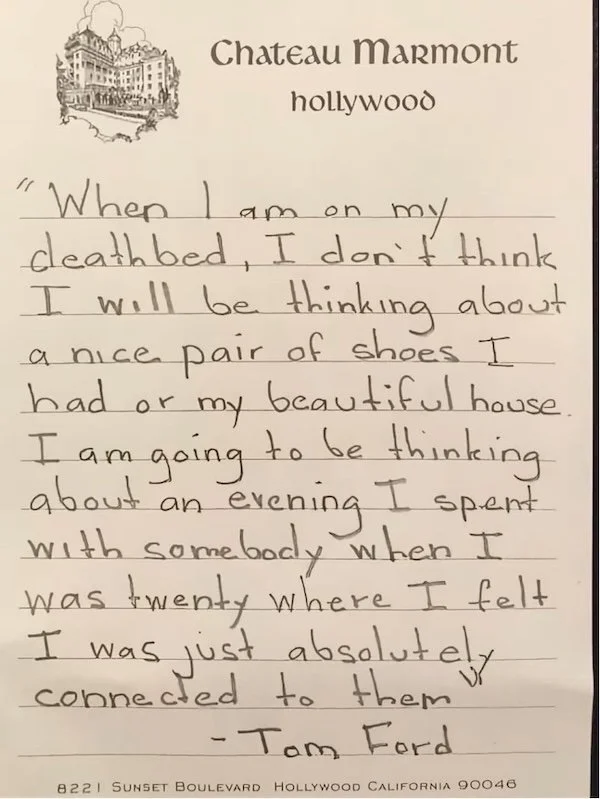
A handwritten note from the Chateau Marmont, Hollywood.
Whether you are a multi-millionaire designer or a bloke catching up with his mates at the Wenlock House pub, the ultimate human goal is exactly the same: connection.
We spend so much of our lives chasing the next milestone, the bigger house, or the pristine investment portfolio. But money is never the end game. It is simply the fuel. The real destination is the freedom to spend a Tuesday afternoon laughing with old friends, or knowing your family is secure enough to just enjoy each other's company.
Human relationships are much, much more important than belongings.
In Chancery Lane we spend our working lives on timescale, costs and returns. We believe in all three, and we will defend every basis point of saved cost to the last. But we would be doing you a disservice if we let you think the spreadsheet was the point.
It is not. The pension, the ISA, the carefully balanced portfolio - these are not the destination. They are the scooter. They exist to carry you to the pub, to the grandchildren, to the friend you have known for fifty years, to the evening you will still be thinking about on your last day. Belongings fade from memory almost as soon as we own them. The evenings, the connections, the people - those are what stay.
Which brings us back to the Grandads of Anarchy. They have, we suspect, worked all this out without a single spreadsheet. They have decided that the money is for living, the afternoon is for friends, and that growing older is no excuse to stop turning up. They are, frankly, our kind of clients.
Our job is simply to make sure the money never gets in the way of the life. Get the three ingredients right - quietly, in the background, year after year - and you are free to forget about them entirely and go and be absolutely connected to the people who matter.
That, in the end, is the whole point of the work: a design for life.
Book a no-obligation Income Discovery Meeting
About the author
Doug Brodie is Founder and CEO of Chancery Lane Income Planners. He has specialised in retirement income for over thirty years, face to face, and is Chartered with both the CISI and CII. His first clients from 1989 are still with this firm. This article is general information and not personal advice. Tax rules can change, and the impact of any planning depends on your specific circumstances. Capital is at risk and past performance is not a guide to future returns.