
Won’t Get Fooled Again

by Doug Brodie
In this blog:
[1] ‘Mister, I don’t sell to fish’ - who the product is really designed for
[2] You think. AI does not. What it got wrong about my own State Pension
[3] There went $2.3 trillion dollars, and here most of it comes back
[4] A worked example: Alan, Barbara and a 25 % fall
[5] Why the money pages never say "nothing to see here"
[6] On age, boredom, and brothers who fall out – the Miliband Mess
The Who released Won’t Get Fooled Again in 1971, on Who’s Next. Pete Townshend wrote it, Roger Daltrey delivered that scream, and the last line is the one everybody remembers: Meet the new boss, same as the old boss. Townshend was writing about political revolutions that change the name on the letterhead and nothing else. It works just as well as a description of the retail investment industry, which reinvents its packaging roughly every eighteen months and its economics almost never.
[1] Mister, I don’t sell to fish
Munger’s fishing tackle story is the single most useful thing I know about financial products, and it takes eleven words.
The purple and green lure is not a piece of ichthyology. It is a piece of marketing. It sits at eye level on the shelf because it catches the eye of a man standing in a shop on a Saturday morning, and the shopkeeper is entirely relaxed about whether it ever catches anything with gills.
Now walk that back into your own financial life and ask the awkward question about every product you own. Who was this designed to appeal to? Not who does it serve, which is a different and much more flattering question. Who does it appeal to?
Three quick examples of the difference.
A structured product with a headline "up to 8 %" return. The eight is the lure. The conditions attached to it are the hook, and they are printed in the section nobody reads.
A fund named after the thing everyone is currently worried about, launched about four months after everyone started worrying. The naming is the lure. Fund houses launch what will sell, which is by definition what has recently done well.
A platform advertising zero commission. The zero is the lure. The revenue arrives from the foreign exchange spread, the cash interest retained, or the payment for order flow, none of which appear on your statement, their hidden hand in your wallet.
None of that is fraud. All of it is entirely legal, and most of it is disclosed somewhere. It is simply an industry doing what industries do, which is to design the thing that sells rather than the thing that works. Ethics? Pah, can’t compete with £million pay packets.
The defence is not cynicism. The defence is the one-sentence test at the top of this piece. If you can say plainly how a holding produces your income, you probably own it for a reason. If you cannot, you may have bought a lure.

[2] You think. AI does not.
We use AI here, mostly for research and development, and some of what it does is genuinely staggering. It is also, on occasion, exactly like a very clean and shiny second-hand car that you buy because it looks fantastic and which turns out four days later to have a fatal fault in the engine.
One morning, somewhere between the porridge and the second coffee, the triple lock was in the news yet again and I wondered idly how our State Pension compares with everybody else’s. This is precisely the sort of question AI is brilliant at. It is also precisely the sort of question where you need to know the subject already in order to spot what has gone wrong.
If you are over 55, you would have caught the problem in about four seconds. Here are the three errors that come up most often on this exact question, and each of them would send a reader badly astray.
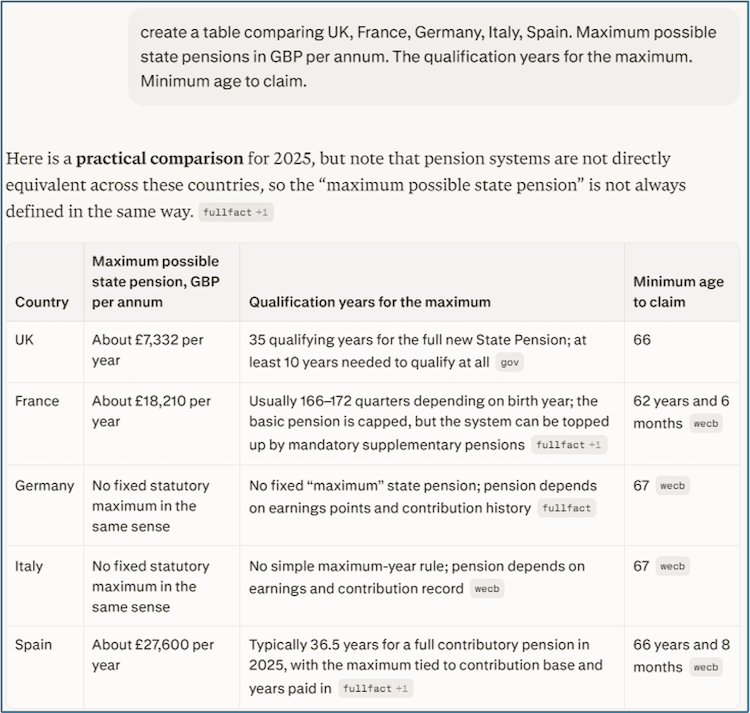
Stating the UK State Pension age is 66, and the rise to 67 is being phased in for people born on or after 6 April 1960. If you are in your sixties, you know your own date, because you have looked it up more than once.
Quoting the full new State Pension as though everyone receives it. The new State Pension applies to men born on or after 6 April 1951 and women born on or after 6 April 1953, and the full rate needs 35 qualifying years. A great many readers of this newsletter are on the old basic State Pension plus an additional pension, which is a different sum arrived at a different way.
Lining up headline rates across countries without mentioning that Australia’s Age Pension is means-tested on both income and assets. Comparing a means-tested benefit with a contributory one on a single chart is not a comparison. It is a category error with a nice bar chart on top.
The full new State Pension is £12,547.60 a year in 2026-27, the figure we used in the summer piece on international comparisons. Get the starting number or the eligibility rule wrong and every calculation downstream of it is wrong too, delivered with total confidence and impeccable formatting.
In the same vein, I asked it for good real ale pubs near me and it got that comprehensively wrong as well. Which is the whole lesson in miniature: I spotted the pub errors instantly because I know the pubs. I spotted the pension errors instantly because I know the pensions. In a field where you know neither, you will not spot anything at all, and the answer will look just as clean and just as shiny.
If you are asking an AI tool for solutions in an area where you have no knowledge and no experience, you can come very, very unstuck. Like buying a clean and shiny car where you only discover the faulty engine a week later.
[3] There went $2,300,000,000,000, and here most of it comes back
The seven big American technology companies - Alphabet, Amazon, Apple, Meta, Microsoft, Nvidia and Tesla - reached a combined record value of around $22.3 trillion on 29 October 2025.
What followed is worth setting out plainly, because most people lived through all of it and noticed none of it.
They slid through the early part of 2026 while the rest of the market held up rather better, then recovered to reach a fresh record in late May.
In June 2026 alone, around $2.3 trillion was wiped off their combined value, with the CNBC Magnificent 7 Index down 10 % over the month. Microsoft fell about 17 % in June, its biggest monthly decline since December 2000. Amazon fell about 12 % and Meta about 11 %.
On 23 July they had their worst single day since April 2025, dropping 4.8 % and roughly $767 billion in one session, leaving the group about 11 % below its May record and some $ 2 trillion lighter.
Then in August they rallied hard on the back of strong Nvidia results, and by the start of September the group was back to roughly where it started the year.
Source for the June figure: CNBC, 30 June 2026, "Mag 7 value shrinks by $2.3 trillion amid AI spending jitters". The July single-day figure is from the Bloomberg Magnificent 7 Index.
Read that sequence again. Two point three trillion dollars evaporated in a month, then largely reassembled itself over the summer, and unless you follow this for a living you almost certainly registered neither event.
Which raises the question this whole blog is built around. If a movement of that size can pass over your head without disturbing your sleep, what exactly is your portfolio for? And if it did disturb your sleep, what did you do about it, and was that a good idea?
The stock market’s job is to tell you the price at which today’s traders will deal in a share, that is all it does. It does not tell you what a company is worth. The core principle of value investing is that the price paid contains a margin of safety, and where that margin exists, day-to-day fluctuations can be ignored. Being paid while you wait is what makes the ignoring psychologically possible. Cashflow can be compared with cash, and an investment that produces cashflow can be valued with more certainty than ‘taking a view’.
[4] A worked example: Alan, Barbara and a 25 % fall
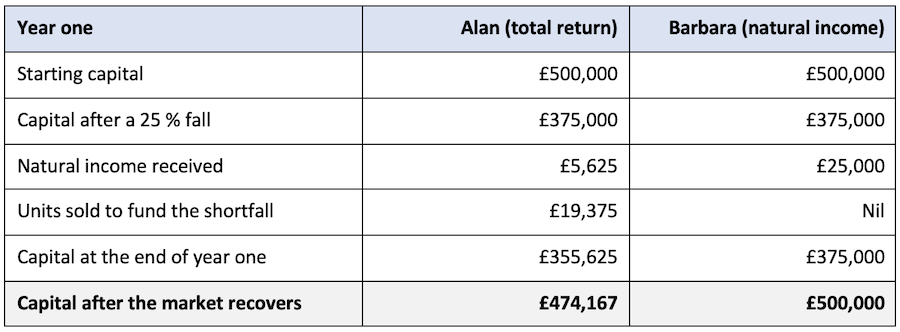
Two retirees, both aged 68. Both have £500,000. Both need £25,000 a year, and both are drawing that income from the pot.
Alan holds a growth portfolio yielding 1.5 %. Barbara holds an income portfolio yielding 5 %. In year one, the market falls 25 %.
Alan, first, step by step.
Capital after the fall: £500,000 x 0.75 = £375,000
Natural income received: £375,000 x 1.5 % = £5,625
Shortfall to be met by selling units: £25,000 - £5,625 = £19,375
Capital at the end of year one: £375,000 - £19,375 = £355,625
Proportion of the fund sold: £19,375 divided by £375,000 = 5.17 %
Had the market been flat, Alan would have sold £17,500 out of £500,000, which is 3.5 %. The fall forced him to sell nearly half as many units again to raise the same amount of money. Those units are gone.
Barbara, next.
Capital after the fall: £500,000 x 0.75 = £375,000
Natural income received: £375,000 x 5 %, but the dividends were declared from investment trusts, so the cash received is approximately £25,000
Shortfall to be met by selling units: nil
Capital at the end of year one: £375,000
Now let the market recover fully in year two, meaning it rises by one third and returns to where it began.
Alan: £355,625 x 1.3333 = £474,167
Barbara: £375,000 x 1.3333 = £500,000
The gap: £500,000 - £474,167 = £25,833
The market went down and came all the way back up. Barbara is whole. Alan is £25,833 short, permanently, and he never made a single decision wrong. The damage was done by the mechanical necessity of selling units at depressed prices to pay the gas bill.
The honest caveats:
First, it assumes both portfolios fall by the same 25 %. In practice, a portfolio yielding 5 % and one yielding 1.5 % hold different things and will not move identically. The example isolates one variable, which is the cost of selling units in a falling market. It is not a claim that income portfolios always outperform growth portfolios.
Second, and more importantly, dividends can be cut. In 2020, UK dividends fell 44 % on a headline basis and 38.1 % on an underlying basis excluding specials, with around two-thirds of companies cutting or cancelling payouts. That was the worst year for UK payouts since the war, and by 2025 UK dividends had still not regained their pre-pandemic level, coming in at £87.5 billion on a headline basis against £110.6 billion in 2019. This is why we use investment trusts – the reserves stop cuts.
So, the honest position is this. Natural income is more predictable and more reliable than total return, because a board declaring a dividend is making a considered decision about its own profits, while a share price is the aggregate mood of strangers. More reliable is not the same as guaranteed, and any adviser who tells you otherwise is selling you a purple and green lure.
There is more detail on how we construct income portfolios in the research published on chancerylane.net.
[5] Why the money pages never say "nothing to see here"
Almost every do-it-yourself investor I meet is, whether they would use the word or not, a trend follower. They take their information from sources designed specifically for the do-it-yourself investor, and where that information is free, or nearly free, somebody else is paying for it. Media gets paid by hook or by stealth.
Here is the thing I notice constantly and cannot un-notice. Open any retail investing publication, daily, weekly or monthly. There will be a section telling you to buy these shares or these funds, because they are terrific.
But what about last week’s recommendations? Are they no longer terrific? Should we sell them to buy this week’s? Hold both? How do the two compare? Why does the column never simply say: “Last month’s picks were excellent, they remain excellent, do nothing this week and go for a walk”?
Because "do nothing" does not fill a page, and a page that is not filled cannot carry advertising. The recommendation is the product. Your outcome is not the product. “Mister, I don’t sell to fish.”
There is a related pattern in trading volume. Volume rises sharply with volatility, and volatility runs highest when prices are falling, which is why the red bars on a volume chart so often tower over the green ones. When the market turns down, do-it-yourself investors tend to disappear, because nobody has told them what to do and the columns that were so confident on the way up have gone quiet.
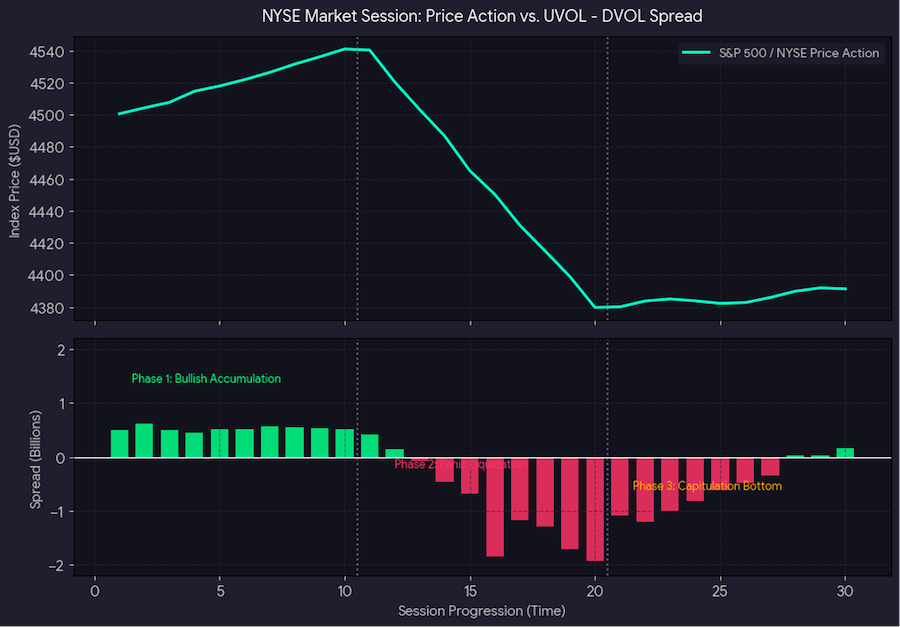
I would add the obvious caution, which is that this is correlation, and the causation runs in several directions at once. Falling prices cause selling, selling causes falling prices, and forced sellers such as leveraged funds trade in size regardless of what anybody thinks. It is a pattern worth knowing rather than a law worth trading on.
[6] On age being just a number
Parkrun does something quietly brilliant that most participants never look at. Alongside your finish time it gives you an age grade, which expresses your time as a percentage of the world best for your age and sex. It means a 71-year-old and a 34-year-old can be compared properly. It also means a great many people in their seventies discover they are, relative to their own cohort, considerably better runners than the twenty-somethings who overtook them on the last bend.
Marcus Aurelius put the same idea rather more elegantly about 1,850 years before parkrun existed:
"Very little is needed to make a happy life; it is all within yourself, in your way of thinking."
(That is from the Meditations, and this is one of several English renderings of a passage usually placed in Book Seven. Translations vary and I cannot vouch for any single one as definitive.)
The financial planning point behind all this is a serious one. The retirement plans that go wrong are rarely the ones with the wrong asset selection. They are the ones built on an assumption about how long the money needs to last that was set once, in your late fifties, and never revisited. A 67-year-old couple today has a meaningful chance of one of them reaching ninety-five. Plans built for eighty-five run out.
[7] The problem with retiring too early
You get bored.
I say this with affection, because I see it constantly. The first six months are marvellous. The garden gets sorted, the loft gets cleared, the long-postponed trip finally happens. Then somewhere around month eight a particular expression arrives, and it is the expression of a person who has run out of jobs.
Three composite examples, drawn from patterns rather than from any one client.
The engineer who retired at 58 with a very healthy pot, spent two years redoing the house, and then took a part-time role at a local college workshop for a fraction of his old salary. He described it as the best financial decision he never planned.
The couple who retired together at 63, having assumed that was the romantic option, and discovered within a year that they had never previously spent seven consecutive days in the same building. She went back to work three days a week and they are much happier.
The retired GP who stopped at 60 and stopped entirely, and whose spending collapsed to about 60 % of what the plan had assumed - not through hardship, but because a person with nothing in the diary buys nothing. The pot grew. So did the eventual Inheritance Tax bill.
That last one connects directly to what we wrote about in the Hotel California piece on pensions and Inheritance Tax from April. Under-spending in retirement is not a virtue. It is frequently the most expensive habit in the whole plan – give your money to the kids whilst they need it. Or set up your own little private charity. Pourquoi pas?
[8] When brothers fight
In September 2010, David Miliband was the clear favourite for the Labour leadership. He led among MPs and MEPs, and he led among party members. His younger brother Ed waded in (why??) and won the final round of the electoral college by roughly 50.7 % to 49.3 %, carried over the line by the trade union section. David left frontline politics shortly afterwards.
Now run the counterfactual - and do please treat it as a bit of Saturday morning fun rather than political analysis. If David had won in 2010, does he beat Cameron in 2015? If he does, there is no Conservative majority, no referendum in 2016, no Brexit, and no Boris Johnson in Downing Street in 2019. An entire decade of British history turning on a margin of about one and a half percentage points in a brothers’ quarrel.
It is unprovable and always will be. Counterfactuals are entertainment, not evidence. But the underlying observation is real enough, and it is one we deal with professionally rather more often than we would like: when siblings fall out, the consequences are wildly disproportionate to the original disagreement.
In our world that shows up in four specific places.
Attorneys under a Lasting Power of Attorney. Appoint two children jointly and severally who do not speak to each other, and you have built a deadlock into your own future care.
Executors. The same problem, arriving at the worst possible moment, with a grieving family and a probate registry that will not proceed without agreement.
Unequal legacies that were never explained. The gift to the child who needed help in 2009, which nobody mentioned to the other two.
The family home, where one child wants to sell, one wants to keep it, and neither can buy the other out.
Every pound of legal cost in a contested estate comes out of the estate, which means it comes out of the children. I do not have a reliable published average for what a contested probate costs and I would rather not quote one than quote a bad one. What I can tell you is that the cause is almost always the same, and it is almost always avoidable: nobody had the conversation while the parent was alive and able to explain their reasoning.
Where a family cannot agree and no Lasting Power of Attorney is in place, the alternative is an application to the Court of Protection, which is slower and considerably more expensive than the LPA that would have prevented it. We covered that in full in the Power to the People piece.
Better still – get a family friend to be the agreed adjudicator, and keep it in the family.
So - one sentence, and a score out of ten
Back to where we started, because it is the only part of this blog that requires anything of you.
One sentence, explaining how your money makes your income. Then a score out of ten for how reliable you expect that to be next year.
If the sentence contains the phrase "it goes up over the long term", that is a description of a hope rather than a mechanism, and the score should be low. If it names what you own, what it pays, and when it pays it, you are in good shape and you should ignore the rest of this paragraph.
The Who got there in 1971. The new boss looks remarkably like the old boss, the lures change colour every season, and the fish are not the customer. Knowing that is most of the defence.
Book a no-obligation Income Discovery Meeting
020 7390 0670
Two hours, both spouses, no jargon, no pitch. We bring the coffee.
You bring the questions, the statements, and your one sentence.
About the author
Doug Brodie is Founder and CEO of Chancery Lane Income Planners. He has specialised in retirement income for over thirty years and is Chartered with both the CISI and CII. This article is general information and not personal advice. Tax rules can change, and the impact of any planning depends on your specific circumstances. Capital is at risk and past performance is not a guide to future returns. The value of income can fall as well as rise and is not guaranteed.